
 |
 |
 |
 |
 |
 |
 |
 |
 |

 |
Cassini To Formally Complete Primary Saturn Mission
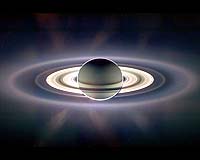
Pasadena CA (SPX) Jun 30, 2008 NASA's Cassini mission is closing one chapter of its journey at Saturn and embarking on a new one with a two-year mission that will address new questions and bring it closer to two of its most intriguing targets-Titan and Enceladus. On June 30, Cassini completes its four-year prime mission and begins its extended mission, which was approved in April of this year. Among other things, Cassini revealed the Earth-like world of Saturn's moon Titan and showed the potential habitability of another moon, Enceladus. These two worlds are primary targets in the two-year extended mission, dubbed the Cassini Equinox Mission. This time period also will allow for monitoring seasonal effects on Titan and Saturn, exploring new places within Saturn's magnetosphere, and observing the unique ring geometry of the Saturn equinox in August of 2009 when sunlight will pass directly through the plane of the rings. "We've had a wonderful mission and a very eventful one in terms of the scientific discoveries we've made, and yet an uneventful one when it comes to the spacecraft behaving so well," said Bob Mitchell, Cassini program manager at NASA's Jet Propulsion Laboratory, Pasadena, Calif. "We are incredibly proud to have completed all of the objectives we set out to accomplish when we launched. We answered old questions and raised quite a few new ones and so our journey continues." A new addition to the Cassini science team is Bob Pappalardo who will step into the role of Cassini Project Scientist in July, taking over for Dennis Matson, a multi-year veteran on the project who will be working on future flagship mission studies to the outer solar system. "I am honored and humbled to be able to work with such a scientifically rich mission, and with the outstanding scientists and engineers who are the backbone of Cassini," said Pappalardo. Pappalardo is a geologist whose research focuses on processes that have shaped the icy moons of the outer solar system, including processes that power the geysers of Saturn's moon Enceladus. He received his bachelor's degree from Cornell University, Ithaca, N.Y., and his Ph.D. in geology from Arizona State University, Tempe. He worked with the Galileo imaging team while a Postdoctoral Researcher at Brown University, Providence, RI. Prior to joining JPL in 2006, he was an assistant professor of planetary sciences at the University of Colorado at Boulder. Currently he resides in Venice, Calif. Cassini launched Oct. 15, 1997, from Cape Canaveral, Fla., on a seven-year journey to Saturn, traversing 3.5 billion kilometers (2.2 billion miles). The mission entered Saturn's orbit on June 30, 2004, and began returning stunning data of Saturn's rings almost immediately. The spacecraft is extremely healthy and carries 12 instruments powered by three radioisotope thermoelectric generators. Data from Cassini's nominal and extended missions could lay the groundwork for possible future missions to Saturn, Titan or Enceladus. Community Email This Article Comment On This Article Share This Article With Planet Earth
Related Links Explore The Ring World of Saturn and her moons Jupiter and its Moons The million outer planets of a star called Sol News Flash at Mercury
 Ocean On Enceladus May Be Short-Lived
 Moffett Field CA (SPX) Jun 23, 2008
The tide may be changing for the ocean suspected under the icy shell of Enceladus. Recent research has shown that this small moon of Saturn does not produce enough heat in its present configuration to keep water from freezing down to its core. |
|
|

| The content herein, unless otherwise known to be public domain, are Copyright 1995-2007 - SpaceDaily.AFP and UPI Wire Stories are copyright Agence France-Presse and United Press International. ESA Portal Reports are copyright European Space Agency. All NASA sourced material is public domain. Additional copyrights may apply in whole or part to other bona fide parties. Advertising does not imply endorsement,agreement or approval of any opinions, statements or information provided by SpaceDaily on any Web page published or hosted by SpaceDaily. Privacy Statement |
 del.icio.us
 Digg
Digg Reddit
 YahooMyWeb
 Google
 Facebook