|
 |
 |
 |
 |
 |
 |
 |
 |

 |
Cassini Studies Saturn E Shepherd Moons Calypso And Helene
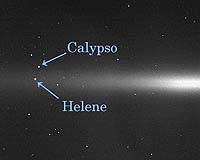
Pasadena CA (SPX) Apr 27, 2006 Cassini has captured an image of Saturn's faint E ring - a feature now known to be created by its moon Enceladus - that also shows the ring's two small shepherd moons. The E ring extends from three to eight Saturn radii -- about 180,000 kilometers (118,000 miles) to 482,000 kilometers (300,000 miles). Its full extent is not visible in this view. Calypso, at 22 kilometers (14 miles) across, and Helene, 32 kilometers (20 miles) across orbit within the E ring's expanse. Helene skirts the outer parts of the ring, but in this image it is projected in front of a region deeper within the ring. Calypso and Helene are so-called trojan satellites, or moons that orbit 60 degrees in front or behind a larger moon. Calypso is a trojan of Tethys and Helene is a trojan of Dione. One interesting feature in the image is the double-banded appearance of the E-ring, created because the ring is somewhat fainter in the ring plane than it is 500-1,000 kilometers (300-600 miles) above and below the ring plane. This appearance implies the particles in this part of the ring have what astronomers call non-zero inclinations (a similar affect is seen in Jupiter's gossamer ring). An object with a non-zero inclination does not orbit exactly at Saturn's ring plane. Instead, its orbit takes it above and below the ring plane. Scientists are not entirely sure why the particles should have such inclinations, but they are fairly certain the reason involves Enceladus. One possible explanation is all the E ring particles come from the plume of icy material shooting due south out of the moon's pole. This means all of the particles are created with a certain velocity out of the ring plane, and then orbit above and below that plane. Another possible explanation is Enceladus produces particles with a range of speeds, but the moon gravitationally scatters any particles that lie very close to the ring plane, giving them non-zero inclinations. Mission controllers at Jet Propulsion Laboratory said stray light within the camera system is responsible for the broad, faint "Y" shape across the image. Cassini took the image in visible light with its wide-angle camera on March 15 at a distance of approximately 2.4 million kilometers (1.5 million miles) from Saturn. The image scale on the sky at the distance of Saturn is 142 kilometers (88 miles) per pixel. Community Email This Article Comment On This Article Related Links Cassini Cassini Images JPL Explore The Ring World of Saturn and her moons Jupiter and its Moons The million outer planets of a star called Sol News Flash at Mercury
 Saturn Storms Dwarf Earth Hurricanes In Size And Longevity
 Pasadena CA (SPX) Apr 20, 2006
Viewed from space, hurricanes on Earth and the huge atmospheric disturbances observed on Saturn look similar, but their differences are greater, offering intriguing insights into the inner workings of the ringed world currently being investigated by NASA's Cassini spacecraft. |
|
|

| The content herein, unless otherwise known to be public domain, are Copyright 1995-2006 - SpaceDaily.AFP and UPI Wire Stories are copyright Agence France-Presse and United Press International. ESA PortalReports are copyright European Space Agency. All NASA sourced material is public domain. Additionalcopyrights may apply in whole or part to other bona fide parties. Advertising does not imply endorsement,agreement or approval of any opinions, statements or information provided by SpaceDaily on any Web page published or hosted by SpaceDaily. Privacy Statement |