|
 |
 |
 |
 |
 |
 |
 |
 |

 |
Cassini Spacecraft Near First Stop In Historic Saturn Tour
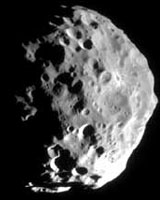
Pasadena (JPL) Jun 11, 2004 The most complex interplanetary mission ever launched is about to meet one of the solar system's enigmatic moons. Cassini will fly by Phoebe, Saturn's largest outer moon, on Friday. The closest approach is at approximately 4:56 p.m. EDT. A final trajectory correction maneuver is scheduled for June 16. On arrival date, June 30, Cassini will become the first spacecraft to orbit Saturn. Once in orbit it will conduct an extensive, four-year tour of the Saturn system, including its majestic rings and many known moons. "The arrival date and trajectory to Saturn were specifically selected to accommodate this flyby, which will be the only opportunity during the mission to study Phoebe at close range," said Dave Seal, mission planner for the Cassini- Huygens mission at NASA's Jet Propulsion Laboratory (JPL), Pasadena, Calif. "Phoebe's orbit is simply too far from Saturn, at almost 13 million kilometers (about 8 million miles), nearly four times as far as the next closest major satellite, Iapetus. A later encounter is not feasible." "The last time we had observations of Phoebe was by Voyager in 1981," said Dr. Torrence Johnson, former Voyager imaging team member, Galileo project scientist and Cassini imaging team member."This time around, the pictures of the mysterious moon will 1,000 times better, as Cassini will be closer," he said. Voyager 2 captured images of Phoebe from about 2.2 million kilometers (about 1.4 million miles) away. Cassini will obtain images from a mere 2,000 kilometers (about 1,240 miles) above the moon's surface. Cassini will also collect spectroscopic and radar data that could decipher the composition and origin of this distant moon. Cassini's Phoebe images, already twice as good as returned by Voyager 2, show large craters and variations in surface brightness. "We anticipate that Phoebe will be heavily cratered in the higher resolution images we expect to see in the next few days," said Dr.Peter Thomas, a member of the imaging team and a senior research associate at Cornell University, Ithaca, N.Y., who specializes in studies of small satellites. "The hints of different brightness also suggest the highest resolution images, several hundred times better, will show a variety of materials," he said. Discovered in 1898 by American astronomer William Henry Pickering, Phoebe is of great interest to scientists. "With the instruments Cassini carries, we might learn more about Phoebe's internal structure and composition. What we have are many unanswered questions: Did it ever melt? Does it have evidence of past interior melting? Was it ever an icy body? Why is Phoebe in such an odd orbit?" Said Dr. Dennis Matson, project scientist for the Cassini-Huygens mission at JPL. Phoebe has a diameter of 220 kilometers (about 136.7 miles), which is equal to about one-fifteenth of the diameter of Earth's moon. Phoebe rotates on its axis every nine hours and 16 minutes, and it completes a full orbit around Saturn in about 18 months. Its elliptical orbit is inclined approximately 30 degrees to Saturn's equator. Phoebe's retrograde orbit means it goes around Saturn in the opposite direction of the larger interior Saturnian moons. Previous ground-based observations have shown water ice present on its surface. Phoebe is also unusual as it is very dark. It reflects only six percent of the sunlight it receives. Phoebe's darkness and retrograde orbit suggest it is most likely a captured object. A captured object is a celestial body caught by the gravitational pull of a much bigger body, generally a planet. Some scientists believe Phoebe might even be an object from the outer solar system, similar to the objects found in the Kuiper Belt. The Belt is a collection of small icy bodies beyond Pluto were never drawn together by gravity to form a planet. "The dark and odd-shaped Phoebe may be a piece of the building blocks from which some of the planets formed," said Dr. Bonnie Buratti, scientist on the Cassini-Huygens mission at JPL. "It might hold clues about the early formation of our solar system." Community Email This Article Comment On This Article Related Links Cassini-Huygens at NASA SpaceDaily Search SpaceDaily Subscribe To SpaceDaily Express Explore The Ring World of Saturn and her moons Jupiter and its Moons The million outer planets of a star called Sol News Flash at Mercury
 Cassini Images Halo Around Titanic Moon Off Saturn
 Pasadena CA (SPX) Dec 27, 2005
With its thick, distended atmosphere, Titan's orange globe shines softly, encircled by a thin halo of purple light-scattering haze. |
|
|

| The content herein, unless otherwise known to be public domain, are Copyright 1995-2006 - SpaceDaily.AFP and UPI Wire Stories are copyright Agence France-Presse and United Press International. ESA PortalReports are copyright European Space Agency. All NASA sourced material is public domain. Additionalcopyrights may apply in whole or part to other bona fide parties. Advertising does not imply endorsement,agreement or approval of any opinions, statements or information provided by SpaceDaily on any Web page published or hosted by SpaceDaily. Privacy Statement |