|
 |
 |
 |
 |
 |
 |
 |
 |

 |
Cassini Set To Ring Saturn Today
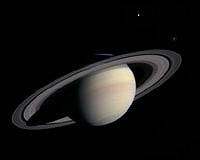
Pasadena (SPX) Jul 01, 2004 After nearly seven years of asking, "Are we there yet?" the Cassini-Huygens mission is poised to enter Saturn's orbit this evening. "Getting into orbit means we have a mission. If we don't get into orbit then we have a flyby and that's not what we are here to do," said Dr. Dennis Matson, project scientist for the Cassini-Huygens mission at NASA's Jet Propulsion Laboratory, Pasadena, Calif. "We are confident that the Cassini team will get us there." Although everything on the spacecraft is performing well, mission managers caution that this is not a slam-dunk by any means. There are risks as with any mission. One of those risks is the ring plane crossing. Although this area has been mapped extensively and is believed to be safe, there is still a risk of an impact to the spacecraft. "There are three hold-your-breath moments for the mission," said Robert T. Mitchell, program manager for the Cassini-Huygens mission at JPL. "The first is when we see the signal coming back after we cross the ring plane in the ascending direction. The second is an indication that the burn has begun at 7:36 p.m. Pacific time (10:36 p.m. EDT). And finally, the signal showing the burn completion at the right time." Another concern is weather that may affect the reception of the signal on Earth. Weather on Earth will not change the outcome of the mission but it will impact whether or not mission controllers will receive a signal during the orbit insertion. Current weather predictions at the Canberra, Australia, station of the Deep Space Network show possible high winds that could effect this evening's operation of that antenna. This evening at 7:11 p.m. PDT (10:11 p.m. EDT), Cassini will cross the ring plane between Saturn's F and G rings. Its antenna will be oriented forward and act as a shield against small particles. At 7:36 p.m. PDT (10:36 p.m. EDT), the spacecraft will begin a critical 96-minute main engine burn. Once the burn is complete the spacecraft will turn and send a signal back to Earth to report how it is doing. Then it will point its cameras and other instruments at the rings. "Orbit insertion is sort of like applying your brakes while driving your car downhill," said Mitchell. "Although you've got your foot on the brakes, you still pick up speed as a steep gravity pulls you in." During the burn, the spacecraft will change its velocity by 626 meters per second (1,400 miles per hour). Relative to Saturn, at burn start the spacecraft speed is 24.26 kilometers per second (54,270 miles per hour) and at the end of the burn the speed is 30.53 kilometers per second (68,293 miles per hour). Mission managers expect periodic interruptions of the Doppler signal as Cassini passes behind the rings. The team that got the spacecraft to Saturn may be one of the most seasoned teams to work on a large mission like Cassini, mostly due to the fact they have flown the spacecraft for seven years. "We've had nearly seven years to iron out the wrinkles," said Julie Webster, spacecraft team chief at JPL. "We are ready. In many ways, the most exciting part of the journey is about to begin because we don't know what lies ahead." "We've been driving this bus for nearly 3.5 billion kilometers (2.2 billion miles)," said Dr. Jeremy Jones, navigation team chief of the Cassini-Huygens mission at JPL. "The trip has sort of been like a long car drive, and we can't wait to get out there and explore the sites. In a sense the tour is just beginning." The arrival period provides a unique opportunity for scientists to observe Saturn's rings and the planet itself. The spacecraft's closest approach to Saturn during the entire mission is at 9:03 p.m. PDT. Its distance from the center of Saturn will be 80,230 kilometers (49,850 miles) and 19,980 kilometers (12,400 miles) from the cloud tops. Community Email This Article Comment On This Article Related Links Cassini at JPL Cassini Image Team SpaceDaily Search SpaceDaily Subscribe To SpaceDaily Express Explore The Ring World of Saturn and her moons Jupiter and its Moons The million outer planets of a star called Sol News Flash at Mercury
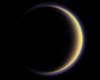
 Cassini Images Halo Around Titanic Moon Off Saturn
 Pasadena CA (SPX) Dec 27, 2005
With its thick, distended atmosphere, Titan's orange globe shines softly, encircled by a thin halo of purple light-scattering haze. |
|
|

| The content herein, unless otherwise known to be public domain, are Copyright 1995-2006 - SpaceDaily.AFP and UPI Wire Stories are copyright Agence France-Presse and United Press International. ESA PortalReports are copyright European Space Agency. All NASA sourced material is public domain. Additionalcopyrights may apply in whole or part to other bona fide parties. Advertising does not imply endorsement,agreement or approval of any opinions, statements or information provided by SpaceDaily on any Web page published or hosted by SpaceDaily. Privacy Statement |