
 |
 |
 |
 |
 |
 |
 |
 |
 |

 |
Cassini Scientist Comments On Composite Infrared Spectrometer
Pasadena CA (SPX) Aug 14, 2008 All sorts of emotions over the last couple of days. Yesterday morning began with the great (but not surprising) news that our trusty spacecraft had successfully negotiated its latest and deepest- yet passage through the Enceladus plume, successfully executed its observations, and was starting to ship its cargo of data home. There wouldn't be any calibrated data to look at for hours, so I focused for a while on something much more down-to-Earth: my wife Jane and I put in an hour harvesting produce at a local vegetable garden. Searching through the luxuriant, dripping-wet foliage for green beans and tomatoes, Jane remarked, "Isn't it amazing what can happen on a planet that has water on it"? That of course, is part of the reason why we're so excited to be exploring Enceladus--the geysers breaking through that intensely cold surface harbor heat, lots of it, maybe enough to melt the ice below the surface and, just maybe, enough to give Enceladus its own chance for life. Maybe our new Composite Infrared Spectrometer (CIRS) observations of Enceladus' internal heat, now on their way home, could give us new clues about whether liquid water really does lurk beneath the surface. The rest of the day was an exercise in patience as we waited for the CIRS data to be calibrated at CIRS's home at NASA's Goddard Spaceflight Center in Greenbelt, Md., a complicated and time-consuming process. By late afternoon, right before I had to leave for the evening, we got a nibble--a short sequence of data from the few minutes right after closest approach. The processed data ended, tantalizingly, just before our planned stare at the active fracture Damascus Sulcus, which we hoped, if targeting was perfect, would give us perhaps our best-yet determination of the temperatures of the tiger stripe fractures. But something bothered me--CIRS was operating in a mode that I didn't expect. Had something gone wrong with the instrument commanding? It was too late in the day to check with the folks in Maryland. That worry preyed on my mind all evening, so this morning I pounced on the data as soon as I could, to run some more checks. To my great relief, everything was fine--I had forgotten that we had planned to use that unfamiliar instrument mode for this unusual close-up observation. Still, the rest of our data were still not calibrated, and I had to wait a bit longer. In the meantime, there were the close-up ISS camera images to look at. Like the other bloggers here, I was blown away by both the quality of the images, which were taken under very difficult circumstances, and by the bizarre landscape that they revealed. Utterly stunning. Hats off to the imaging team, particularly (as Bonnie and Carolyn also mentioned) to Paul Helfenstein, who sweated for months on the details of planning that sequence. Then, finally, it was our turn--the Goddard team completed the CIRS calibration this morning, and I downloaded the data. More nervousness, until the plots started coming up on the screen and showed a beautiful spike in the signal strength, right when we expected to be staring at Damascus. It was obvious that we were pointing right at the warm fracture, just as planned. We nailed it! Not that CIRS gets credit for this bit of precision targeting--the camera team was driving and we were along for the ride. Credit goes once more to Paul Helfenstein and rest of the ISS team, and also the navigation team who put the spacecraft exactly where it was supposed to be. Now we have to delve deeper to find out what that beautiful observation of Damascus is telling us. Community Email This Article Comment On This Article Share This Article With Planet Earth
Related Links Cassini Explore The Ring World of Saturn and her moons Jupiter and its Moons The million outer planets of a star called Sol News Flash at Mercury
 Cassini Begins Transmitting Data From Enceladus Flyby
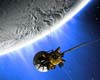 Pasadena CA (SPX) Aug 13, 2008
Shorty after 9:03 p.m. Pacific Time, the Cassini spacecraft began sending data to Earth following a close flyby of Saturn's moon Enceladus. During closest approach, Cassini successfully passed only 50 kilometers (30 miles) from the surface of the tiny moon. |
|
|

| The content herein, unless otherwise known to be public domain, are Copyright 1995-2007 - SpaceDaily.AFP and UPI Wire Stories are copyright Agence France-Presse and United Press International. ESA Portal Reports are copyright European Space Agency. All NASA sourced material is public domain. Additional copyrights may apply in whole or part to other bona fide parties. Advertising does not imply endorsement,agreement or approval of any opinions, statements or information provided by SpaceDaily on any Web page published or hosted by SpaceDaily. Privacy Statement |
 del.icio.us
 Digg
Digg Reddit
 YahooMyWeb
 Google
 Facebook