|
 |
 |
 |
 |
 |
 |
 |
 |

 |
Cassini Rings The Bell
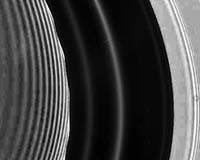
Los Angeles - Jul 02, 2004 The first pictures taken by the Cassini spacecraft after it began orbiting Saturn show breathtaking detail of Saturn's rings, and other science measurements reveal that Saturn's magnetic field pulsed in size as Cassini approached the planet. "For years, we've dreamed about getting pictures like this. After all the planning, waiting and worrying, just seeing these first images makes it all worthwhile," said Dr. Charles Elachi, Cassini radar team leader and director of NASA's Jet Propulsion Laboratory, Pasadena, Calif. "We're eager to share these new views and the exciting discoveries ahead with people around the world." The narrow angle camera on Cassini took 61 images soon after the main engine burn that put Cassini into orbit on Wednesday night. The spacecraft was hurtling at 15 kilometers per second (about 34,000 miles per hour), so only pieces of the rings were targeted. "We won't see the whole puzzle, only pieces, but what we are seeing is dramatic," said Dr. Carolyn Porco, Cassini imaging team leader, Space Science Institute, Boulder, Colo. "The images are mind-boggling, just mind-boggling. I've been working on this mission for 14 years and I shouldn't be surprised, but it is remarkable how startling it is to see these images for the first time." Some images show patterned density waves in the rings, resembling stripes of varying width. Another shows a ring's scalloped edge. "We do not see individual particles but a collection of particles, like a traffic jam on a highway," Porco said. "We see a bunch of particles together, then it clears up, then there's traffic again." Other instruments on Cassini besides the camera have also been busy collecting data. The magnetospheric imaging instrument took the first image of Saturn's magnetosphere. "With Voyager we inferred what it looked like, in the same way that a blind man feels an elephant. Now we can see the elephant," said Dr. Tom Krimigis of Johns Hopkins Applied Physics Laboratory, Laurel, Md., principal investigator for the magnetospheric imaging instrument. The magnetosphere is a bubble of energetic particles around the planet shaped by Saturn's magnetic field and surrounded by the solar wind of particles speeding outward from the Sun. "During approach to Saturn, Cassini was greeted at the gate," said Dr. Bill Kurth, deputy principal investigator for the radio and plasma wave science instrument onboard Cassini. "The bow shock where the solar wind piles into the planet's magnetosphere was encountered earlier than expected. It was as if Saturn's county line had been redrawn, and that was a surprise." Cassini first crossed the bow shock about 3 million kilometers (1.9 million miles) from Saturn, which is about 50 percent farther from the planet than had been detected by the Pioneer, Voyager 1 and Voyager 2 spacecraft that flew past Saturn in 1979, 1980 and 1981. The location of the bow shock varies with how hard the solar wind is blowing, Kurth said. As the magnetosphere repeatedly expanded and contracted while Cassini was approaching Saturn, the spacecraft crossed the bow shock seven times. Community Email This Article Comment On This Article Related Links Cassini at JPL Cassini Image Team SpaceDaily Search SpaceDaily Subscribe To SpaceDaily Express Explore The Ring World of Saturn and her moons Jupiter and its Moons The million outer planets of a star called Sol News Flash at Mercury
 Cassini Images Halo Around Titanic Moon Off Saturn
 Pasadena CA (SPX) Dec 27, 2005
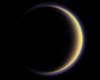
With its thick, distended atmosphere, Titan's orange globe shines softly, encircled by a thin halo of purple light-scattering haze. |
|
|

| The content herein, unless otherwise known to be public domain, are Copyright 1995-2006 - SpaceDaily.AFP and UPI Wire Stories are copyright Agence France-Presse and United Press International. ESA PortalReports are copyright European Space Agency. All NASA sourced material is public domain. Additionalcopyrights may apply in whole or part to other bona fide parties. Advertising does not imply endorsement,agreement or approval of any opinions, statements or information provided by SpaceDaily on any Web page published or hosted by SpaceDaily. Privacy Statement |