|
 |
 |
 |
 |
 |
 |
 |
 |

 |
Cassini Provides New Views of Titan, Saturn's Largest Moon
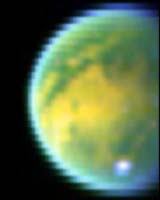
Pasadena (JPL) Jul 03, 2004 The Cassini spacecraft has revealed surface details of Saturn's moon Titan and imaged a huge cloud of gas surrounding the planet-sized moon. Cassini gathered data before and during a distant flyby of the orange moon yesterday. Titan's dense atmosphere is opaque at most wavelengths, but the spacecraft captured some surface details, including a possible crater, through wavelengths in which the atmosphere is clear. "Although the initial images appear bland and hard to interpret, we're happy to report that, with a combination of instruments, we have indeed seen Titan's surface with unprecedented clarity. We also look forward to future, much closer flybys and use of radar for much greater levels of surface detail," said Dr. Dennis Matson of NASA's Jet Propulsion Laboratory, Pasadena, Calif., project scientist for the international Cassini-Huygens mission. Cassini's visible and infrared mapping spectrometer pierced the smog that enshrouds Titan. This instrument, capable of mapping mineral and chemical features of the moon, reveals an exotic surface bearing a variety of materials in the south and a circular feature that may be a crater in the north. Near-infrared colors, some three times redder than the human eye can see, reveal the surface with unusual clarity. "At some wavelengths, we see dark regions of relatively pure water ice and brighter regions with a much higher amount of non-ice materials, such as simple hydrocarbons. This is different from what we expected. It's preliminary, but it may change the way we interpret light and dark areas on Titan," said JPL's Dr. Kevin Baines, Cassini science-team member. "A methane cloud is visible near the south pole. It's made of unusually large particles compared to the typical haze particles surrounding the moon, suggesting a dynamically active atmosphere there." This is the first time scientists are able to map the mineralogy of Titan. Using hundreds of wavelengths, many of which have never been used in Titan imaging before, they are creating a global map showing distributions of hydrocarbon-rich regions and areas of icy material. Cassini's camera also sees through the haze in some wavelengths. "We're seeing a totally alien surface," said Dr. Elizabeth Turtle of the University of Arizona, Tucson. "There are linear features, circular features, curvilinear features. These suggest geologic activity on Titan, but we really don't know how to interpret them yet. We've got some exciting work cut out for us." Since entering orbit, Cassini has also provided the first view of a vast swarm of hydrogen molecules surrounding Titan well beyond the top of Titan's atmosphere. Cassini's magnetospheric imaging instrument, first of its kind on any interplanetary mission, provided images of the huge cloud sweeping along with Titan in orbit around Saturn. The cloud is so big that Saturn and its rings would fit within it. "The top of Titan's atmosphere is being bombarded by highly energetic particles in Saturn's radiation belts, and that is knocking away this neutral gas," said Dr. Stamatios Krimigis of Johns Hopkins Applied Physics Laboratory, Laurel, Md., principal investigator for the magnetospheric imager. "In effect, Titan is gradually losing material from the top of its atmosphere, and that material is being dragged around Saturn." The study of Titan, Saturn's largest moon, is one of the major goals of the Cassini-Huygens mission. Titan may preserve in deep-freeze many chemical compounds that preceded life on Earth. Friday's flyby at a closest distance of 339,000 kilometers (210,600 miles) provided Cassini's best look at Titan so far, but over the next four years, the orbiter will execute 45 Titan flybys as close as approximately 950 kilometers (590 miles). This will permit high-resolution mapping of the moon's surface with an imaging radar instrument, which can see through the opaque haze of Titan's upper atmosphere. In January 2005, the Huygens probe that is now attached to Cassini will descend through Titan's atmosphere to the surface. During the ring plane crossing, the radio and plasma wave science instrument on Cassini measured little puffs of plasma produced by dust impacts. While crossing the plane of Saturn's rings, the instrument detected up to 680 dust hits per second. "The particles are comparable in size to particles in cigarette smoke," said Dr. Don Gurnett of the University of Iowa, Iowa City, principal investigator for the instrument. "When we crossed the ring plane, we had roughly 100,000 total dust hits to the spacecraft in less than five minutes. We converted these into audible sounds that resemble hail hitting a tin roof." The spacecraft reported no unusual activity due to the hits and performed flawlessly, successfully going into orbit around Saturn on June 30. The engine burn for entering orbit went so well that mission managers have decided to forgo an orbital-adjustment maneuver scheduled for today. Community Email This Article Comment On This Article Related Links Cassini at JPL Cassini Image Team SpaceDaily Search SpaceDaily Subscribe To SpaceDaily Express Explore The Ring World of Saturn and her moons Jupiter and its Moons The million outer planets of a star called Sol News Flash at Mercury
 Cassini Images Halo Around Titanic Moon Off Saturn
 Pasadena CA (SPX) Dec 27, 2005
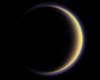
With its thick, distended atmosphere, Titan's orange globe shines softly, encircled by a thin halo of purple light-scattering haze. |
|
|

| The content herein, unless otherwise known to be public domain, are Copyright 1995-2006 - SpaceDaily.AFP and UPI Wire Stories are copyright Agence France-Presse and United Press International. ESA PortalReports are copyright European Space Agency. All NASA sourced material is public domain. Additionalcopyrights may apply in whole or part to other bona fide parties. Advertising does not imply endorsement,agreement or approval of any opinions, statements or information provided by SpaceDaily on any Web page published or hosted by SpaceDaily. Privacy Statement |