Energy News  
Cassini Images Reveal Spectacular Evidence Of An Active Moon

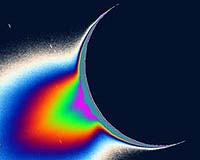
Recent Cassini images of Saturn's moon Enceladus backlit by the sun show the fountain-like sources of the fine spray of material that towers over the south polar region. Image credit: NASA/JPL/Space Science Institute.

Pasadena CA (JPL) Dec 07, 2005
Jets of fine, icy particles streaming from Saturn's moon Enceladus were captured in recent images from NASA's Cassini spacecraft. The images provide unambiguous visual evidence that the moon is geologically active.

"For planetary explorers like us, there is little that can compare to the sighting of activity on another solar system body," said Dr. Carolyn Porco, Cassini imaging team leader at the Space Science Institute in Boulder, Colo.

"This has been a heart-stopper, and surely one of our most thrilling results."

The Cassini images clearly show multiple jets emanating from the moon's south polar region. Based on earlier data, scientists strongly suspected these jets arise from warm fractures in the region. The fractures, informally dubbed "tiger stripes," are viewed essentially broadside in the new images.

The fainter, extended plume stretches at least 186 kilometers (300 miles) above the surface of Enceladus, which is only 186 kilometers wide. Cassini flew through the plume in July, when it passed a few hundred kilometers above the moon.

During that flyby, Cassini's instruments measured the plume's constituent water vapor and icy particles.

Imaging team members analyzed images of Enceladus taken earlier this year at similar viewing angles. It was a rigorous effort to demonstrate that earlier apparitions of the plumes, seen as far back as January, were in fact real and not due to imperfections in the camera.

The recent images were part of a sequence planned to confirm the presence of the plumes and examine them in finer detail. Imaging team member Dr. Andrew Ingersoll from the California Institute of Technology, said, "I think what we're seeing are ice particles in jets of water vapor that emanate from pressurized vents. To form the particles and carry them aloft, the vapor must have a certain density, and that implies surprisingly warm temperatures for a cold body like Enceladus."

Imaging scientists are comparing the new views to earlier Cassini data in hopes of arriving at a more detailed, three-dimensional picture of the plumes and understanding how activity has come about on such a small moon. They are not sure about the precise cause of the moon's unexpected geologic vitality.


Community
Email This Article
Comment On This Article

Related Links
Caltech
Cassini-Huygens at JPL
Cassini Imaging Team
SpaceDaily
Search SpaceDaily
Subscribe To SpaceDaily Express
Explore The Ring World of Saturn and her moons
Jupiter and its Moons
The million outer planets of a star called Sol
News Flash at Mercury


Memory Foam Mattress Review
Newsletters :: SpaceDaily :: SpaceWar :: TerraDaily :: Energy Daily
XML Feeds :: Space News :: Earth News :: War News :: Solar Energy News


Cassini Images Halo Around Titanic Moon Off Saturn
Pasadena CA (SPX) Dec 27, 2005
With its thick, distended atmosphere, Titan's orange globe shines softly, encircled by a thin halo of purple light-scattering haze.


  • Harnessing The Heating And Cooling Powers Of The Sun
  • Is The Flow Of Oil Assured
  • Fuel Cells Could Save Air Force Thousands
  • Poison + Water = Hydrogen. New Microbial Genome Shows How

  • Chinese PM Eyes Nuclear Future In France
  • India Joins International Fusion Project In France
  • Boost To India-US Nuclear Deal
  • British PM Announces Nuclear-Focused Energy Review

  • What Is A Cloud
  • Getting To The TOPP Of Houston's Air Pollution
  • Scientists Seek Sprite Light Source

  • ESA Presents Space Solution To Montreal Forest Conference
  • Modern Forests Suffer From Century Old Logging Legacy
  • Tree Species Regulate Themselves In Ecological Communities
  • Tropical Dry Forests Receive International Recognition

  • Fishing Inland Waters Putting Pressure On Fish Stocks
  • Ancient Canals Reveal Underpinnings Of Early Andean Civilization
  • Oil Mist Reduces Airborne Hazards In Concentrated Swine Feeding Operation
  • Swiss Approve Five-Year Ban On GM In Farming

  • GM Hires Russian Nuclear Scientists To Develop New Auto Technology
  • Japan Creates The World's Fastest Electric Sedan
  • Motorists To Pay 'Congestion' Charge Over Broader Swath Of London
  • Solar Cars Driving Towards A Hydrogen Future

  • India To Buy MiG Jets From Russia
  • IAI To Supply Virtual Mission Training System For T6B Aircraft
  • China Negotiating Major Airbus Purchase Source
  • AirAsia To Dramatically Expand On Wings Of New Airbus Planes

  • NASA plans to send new robot to Jupiter
  • Los Alamos Hopes To Lead New Era Of Nuclear Space Tranportion With Jovian Mission
  • Boeing Selects Leader for Nuclear Space Systems Program
  • Boeing-Led Team to Study Nuclear-Powered Space Systems

  • The content herein, unless otherwise known to be public domain, are Copyright 1995-2006 - SpaceDaily.AFP and UPI Wire Stories are copyright Agence France-Presse and United Press International. ESA PortalReports are copyright European Space Agency. All NASA sourced material is public domain. Additionalcopyrights may apply in whole or part to other bona fide parties. Advertising does not imply endorsement,agreement or approval of any opinions, statements or information provided by SpaceDaily on any Web page published or hosted by SpaceDaily. Privacy Statement