|
 |
 |
 |
 |
 |
 |
 |
 |

 |
Cassini Images Of Titan Reveal An Active, Earth-Like World
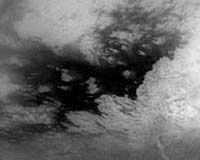
Pasadena CA (JPL) Mar 10, 2005 Saturn's largest and hazy moon, Titan, has a surface shaped largely by Earth-like processes of tectonics, erosion, winds, and perhaps volcanism. The findings are published in this week's issue of the journal Nature. Titan, long held to be a frozen analog of early Earth, has liquid methane on its cold surface, unlike the water found on our home planet. Among the new discoveries is what may be a long river, roughly 1,500 kilometers long (930 miles). Scientists have also concluded that winds on Titan blow a lot faster than the moon rotates, a fact long predicted but never confirmed until now. Tectonism (brittle fracturing and faulting) has clearly played a role in shaping Titan's surface. "The only known planetary process that creates large-scale linear boundaries is tectonism, in which internal processes cause portions of the crust to fracture and sometimes move either up, down or sideways," said Dr. Alfred McEwen, Cassini imaging team member from the University of Arizona, Tucson. "Erosion by fluids may accentuate the tectonic fabric by depositing dark materials in low areas and enlarging fractures. This interplay between internal forces and fluid erosion is very Earth-like." Cassini images collected during close flybys of the moon show dark, curving and linear patterns in various regions on Titan, but mostly concentrated near the south pole. Some extend up to 1,500 kilometers (930 miles) long. Images from the European Space Agency's Huygens probe show clear evidence for small channels a few kilometers long, probably cut by liquid methane. Cassini imaging scientists suggest that the dark, curved and linear patterns seen in the Cassini orbiter images of Titan may also be channels, though there is no direct evidence for the presence of fluids. If these features are channels, it would make the ones near the south pole nearly as long as the Snake River, which originates in Wyoming and flows across four states. Since most of the cloud activity observed on Titan by Cassini has occurred over the south pole, scientists believe this may be where the cycle of methane rain, channel carving, runoff, and evaporation is most active, a hypothesis that could explain the presence of the extensive channel-like features seen in this region. In analyzing clouds of Titan's lower atmosphere, scientists have concluded that the winds on Titan blow faster than the moon rotates, a phenomenon called super-rotation. In contrast, the jet streams of Earth blow slower than the rotation rate of our planet. "Models of Titan's atmosphere have indicated that it should super-rotate just like the atmosphere of Venus, but until now there have been no direct wind measurements to test the prediction," said Cassini imaging team member Dr. Tony DelGenio of NASA's Goddard Institute for Space Studies, in New York. DelGenio made the first computer simulation predicting Titan super-rotation a decade ago. Titan's winds are measured by watching its clouds move. Clouds are rare on Titan, and those that can be tracked are often too small and faint to be seen from Earth. Ten clouds have been tracked by Cassini, giving wind speeds as high as 34 meters per second (about 75 miles per hour) to the east - hurricane strength - in Titan's lower atmosphere. "This result is consistent with the predictions of Titan weather models, and it suggests that we now understand the basic features of how meteorology works on slowly rotating planets," said Del Genio. "We've only just begun exploring the surface of Titan, but what's struck me the most so far is the variety of the surface patterns that we�re seeing. The surface is very complex, and shows evidence for so many different modification processes," said Dr. Elizabeth Turtle, Cassini imaging team associate in the Lunar and Planetary Laboratory at the University of Arizona, Tucson and co-author of one of the papers in Nature. "Throughout the solar system, we find examples of solid bodies that show tremendous geologic variation across their surfaces. One hemisphere often can bear little resemblance to the other," said Dr. Carolyn Porco, Cassini imaging team leader, Space Science Institute, Boulder, Colo. "On Titan, it's very likely to be this and more." These results are based on Cassini orbiter images of Titan collected over the last eight months during a distant flyby of the south pole and three close encounters of Titan's equatorial region. Cassini cameras have covered 30 percent of Titan's surface, imaging features as small as 1 to 10 kilometers (0.6 to 6 miles). Cassini is scheduled to make 41 additional close Titan flybys in the next three years. Community Email This Article Comment On This Article Related Links Cassini-Huygens at JPL Cassini Imaging Team SpaceDaily Search SpaceDaily Subscribe To SpaceDaily Express Explore The Ring World of Saturn and her moons Jupiter and its Moons The million outer planets of a star called Sol News Flash at Mercury
 Titan's Methane Mystery
 Moffett Field CA (SPX) Dec 12, 2005
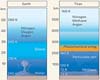
The methane giving an orange hue to Saturn's giant moon Titan likely comes from geologic processes in its interior according to measurements from the Gas Chromatograph Mass Spectrometer (GCMS), a Goddard Space Flight Center instrument aboard the European Space Agency's Huygens Probe. |
|
|

| The content herein, unless otherwise known to be public domain, are Copyright 1995-2006 - SpaceDaily.AFP and UPI Wire Stories are copyright Agence France-Presse and United Press International. ESA PortalReports are copyright European Space Agency. All NASA sourced material is public domain. Additionalcopyrights may apply in whole or part to other bona fide parties. Advertising does not imply endorsement,agreement or approval of any opinions, statements or information provided by SpaceDaily on any Web page published or hosted by SpaceDaily. Privacy Statement |