|
 |
 |
 |
 |
 |
 |
 |
 |

 |
Cassini Gradually Revealing Phoebe's Origin
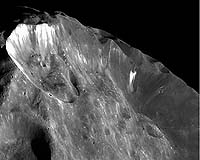
Pasadena CA (JPL) May 30, 2005 Data from the NASA/ESA/ASI Cassini-Huygens mission are providing convincing evidence that Saturn's moon Phoebe was formed elsewhere in the Solar System, and was only later caught by the planet's gravitational pull. One way to unlock Phoebe's secrets is using Cassini's Visible and Infrared Mapping Spectrometer (VIMS), developed by a team of US (JPL), French and Italian (ASI) scientists and engineers. The science team is made by a large international group of US, Italian, French and German scientists led by the University of Arizona. This instrument identifies the chemical compositions of the surfaces, atmospheres and rings of Saturn and its moons by measuring colours of visible light and infrared energy emitted or reflected (spectra). The origin of Phoebe, which is the outermost large satellite of Saturn, is of particular interest because its orbit is in the opposite direction (retrograde) and inclined at a different angle to Saturn's regular satellites (with 'prograde', low-inclination circular orbits). Phoebe's generally dark surface shows evidence of water ice, but otherwise the surface most closely resembles that of asteroids and small outer Solar System bodies such as Chiron and Pholus that are thought to have originated in the Kuiper belt. Recent results from VIMS suggest that Phoebe was gravitationally 'captured' by Saturn, having formed from ice and rocks 'accreting', or joining together, outside the region of the 'solar nebula' gas and dust in which Saturn formed. The other moons probably accreted within the nebula in which Saturn itself formed. VIMS made its observations during the close fly-by of Phoebe by Cassini-Huygens on 11 June 2004. The composition of Phoebe should reflect the composition of the region of the solar nebula where it formed. If it originated in the region of the main asteroid belt, it should consist largely of 'mafic' minerals, which are silicate rocks and magmas with relatively high amounts of heavier elements. However, the presence of highly volatile substances (i.e. lots of water and carbon dioxide ice or other carbon-based compounds) does not support strongly this hypothesis. Alternatively then, it could have formed where the Kuiper belt objects originated in the 'volatile-rich' outer solar nebula. Spectra of Phoebe display a wealth of information, indicating a surface containing distinct locations iron-bearing minerals, bound water, trapped carbon dioxide, silicates, organics, nitriles and cyanide compounds. Phoebe is one of the most compositionally diverse objects yet observed in our Solar System. The only body imaged to date that is more diverse is Earth! Mapping results from VIMS show that water ice is distributed over most of Phoebe's observed surface, but generally shows stronger spectral signatures toward the southern polar region. However, this water ice may only be a surface coating because some crater interiors show less ice deep in the crater and more near the surface. By contrast with the moons around Jupiter, cratering tends to expose fresh ice in the subsurface. This raises the possibility that Phoebe is coated by material of cometary or outer Solar System origin, or that it is formed there. Without information about its deep internal composition, we cannot conclusively say that Phoebe originated in the outer Solar System, but compositional data for the full Saturn system may help to narrow it down. The same broad traces of iron on Phoebe are seen in Saturn's rings, particularly in the Cassini division and the C-ring, and may imply that some materials are common to both Phoebe's surface and the rings. Angioletta Coradini, of the Instituto di Fisica dello Spazio Interplanetario, CNR, Rome, said: "Phoebe's organic and cyanide compositions are unlike any surface yet observed in the inner Solar System, but organics and cyanides have still not yet been definitively detected by the VIMS in any of Saturn rings to date. This may mean that the materials on Phoebe and the rings have different origins.� The detection of compounds with a similar absorption characteristics in their spectra on both Phoebe and Iapetus may indicate that material from Phoebe has struck Iapetus's leading hemisphere. They may have collided or perhaps cometary material has coated both Phoebe and Iapetus. Regardless of its origin, Phoebe's diverse mix of materials is unique among Solar System surfaces observed to date, and the chances are very high that it probably does display primitive materials from the outer Solar System. Community Email This Article Comment On This Article Related Links Cassini-Huygens at JPL Cassini Imaging Team SpaceDaily Search SpaceDaily Subscribe To SpaceDaily Express Explore The Ring World of Saturn and her moons Jupiter and its Moons The million outer planets of a star called Sol News Flash at Mercury
 Cassini Images Halo Around Titanic Moon Off Saturn
 Pasadena CA (SPX) Dec 27, 2005
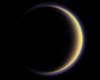
With its thick, distended atmosphere, Titan's orange globe shines softly, encircled by a thin halo of purple light-scattering haze. |
|
|

| The content herein, unless otherwise known to be public domain, are Copyright 1995-2006 - SpaceDaily.AFP and UPI Wire Stories are copyright Agence France-Presse and United Press International. ESA PortalReports are copyright European Space Agency. All NASA sourced material is public domain. Additionalcopyrights may apply in whole or part to other bona fide parties. Advertising does not imply endorsement,agreement or approval of any opinions, statements or information provided by SpaceDaily on any Web page published or hosted by SpaceDaily. Privacy Statement |