|
 |
 |
 |
 |
 |
 |
 |
 |

 |
Cassini Finds Enceladus Tiger Stripes Are Really Cubs
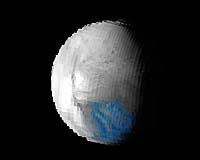
Pasadena CA (JPL) Aug 31, 2005 The Cassini spacecraft discovered the long, cracked features dubbed "tiger stripes" on Saturn's icy moon Enceladus are very young. They are between 10 and 1,000 years old. These findings support previous results showing the moon's southern pole is active. The pole had episodes of geologic activity as recently as 10 years ago. These cracked features are approximately 80 miles long, spaced about 25 miles apart and run roughly parallel to each another. The cracks act like vents. They spew vapor and fine ice water particles that have become ice crystals. This crystallization process can help scientists pin down the age of the features. "There appears to be a continual supply of fresh, crystalline ice at the tiger stripes, which could have been very recently resurfaced," said Dr. Bonnie Buratti. She is a team member of the Cassini visual and infrared mapping spectrometer at NASA's Jet Propulsion Laboratory."Enceladus is constantly evolving and getting a makeover," she added. This finding is especially exciting because ground-based observers have seen tiny Enceladus brighten as its south pole was visible from Earth. Cassini allows scientists to see close up the brightening is caused by geologic activity. When NASA's Voyager 2 spacecraft flew over the moon's north pole in 1981, it did not observe the tiger stripes. Cassini's visual and infrared mapping spectrometer shows water ice exists in two forms on Enceladus. The ice exists in pristine, crystalline ice and radiation-damaged amorphous ice. When ice comes out of the "hot" cracks, or "tiger stripes," at the south pole, it forms as fresh, crystalline ice. As the ice near the poles remains cold and undisturbed, it ages and converts to amorphous ice. Since this process is believed to take place over decades or less, the tiger stripes must be very young. "One of the most fascinating aspects of Enceladus is that it is so very small as icy moons go, but so very geophysically active. It's hard for a body as small as Enceladus to hold onto the heat necessary to drive such large-scale geophysical phenomena, but it has done just that," said Dr. Bob Brown. Brown is a team leader for the visual and infrared mapping spectrometer at the University of Arizona, Tucson. "Enceladus and its incredible geology is a marvelous puzzle for us to figure out," he added. Adding to the already mounting evidence for an active body is the correlation of results from multiple instruments. Cassini's cameras provided detailed images of the south polar cap, in which the tiger stripe fractures were found to be among the hottest features. The timing of the craft's ion and neutral mass spectrometer and the cosmic dust analyzer observations seems to indicate the vapor and fine material are originating from the "hot" polar cap region. These data also indicate the production of water vapor and ejection of fine material are connected, as they are in a comet. This suggests that vapor and dust-sized icy material are coming from the tiger stripes. Enceladus is on a short list of bodies in our solar system where scientists have found internal activity. The others are the volcanoes on Jupiter's moon Io and geysers on Neptune's moon Triton. Data for these measurements were taken during Cassini's closest flyby on July 14, 2005. The spacecraft came within 109 miles of the surface of Enceladus. Enceladus is 314 miles across and has the most reflective surface in the solar system. Community Email This Article Comment On This Article Related Links Cassini-Huygens at JPL Cassini Imaging Team SpaceDaily Search SpaceDaily Subscribe To SpaceDaily Express Explore The Ring World of Saturn and her moons Jupiter and its Moons The million outer planets of a star called Sol News Flash at Mercury
 Cassini Images Halo Around Titanic Moon Off Saturn
 Pasadena CA (SPX) Dec 27, 2005
With its thick, distended atmosphere, Titan's orange globe shines softly, encircled by a thin halo of purple light-scattering haze. |
|
|

| The content herein, unless otherwise known to be public domain, are Copyright 1995-2006 - SpaceDaily.AFP and UPI Wire Stories are copyright Agence France-Presse and United Press International. ESA PortalReports are copyright European Space Agency. All NASA sourced material is public domain. Additionalcopyrights may apply in whole or part to other bona fide parties. Advertising does not imply endorsement,agreement or approval of any opinions, statements or information provided by SpaceDaily on any Web page published or hosted by SpaceDaily. Privacy Statement |