|
 |
 |
 |
 |
 |
 |
 |
 |

 |
Cassini Enters Saturn Orbit
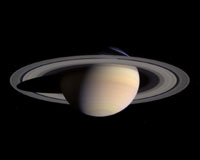
Pasadena (SPX) Jul 01, 2004 The US-European Cassini-Huygens space probe has been captured by Saturn's gravitational field and has begun orbiting the giant planet, after successfully navigating through Saturn's rings, NASA announced late Wednesday. At 9:12 pm (0412 GMT Thursday), the National Aeronautics and Space Administration's Jet Proopulsion Laboratory in Pasadena received a signal from the probe indicating it had shut down its engines thereby ending its orbiting maneuver. "We have burn complete here," said a NASA official to shouts of joy of the dozens of engineers at mission control communications who jumped up from their seats to congratulate each other for a job well done. Eighteen minutes later, exactly on schedule, NASA received another signal from the probe's high-gain antenna indicating that all systems were operating normally and that it was ready to begin it's four-year mission to explore Saturn. "We are ready for the big science pay-off, starting now," said Cassini mission manager Robert Mitchell. The orbiting maneuver ended a seven-year, 3.5 billion-kilometer (2.2 billion-mile) voyage from the launch pad at Cape Canaveral, Florida, to explore the second-largest planet of the solar system. The product of NASA, the European Space Agency and the Italian Space Agency working together, Cassini-Huygens is the first man-made object to orbit around the ringed planet, second in size in the solar system to Jupiter. During its orbit entry, the probe will fly closer to Saturn than it will at any other moment of its four-year mission to come, giving it the chance to study the planet from about 20,000 kilometers (12,000 miles) away. The craft is made up of a US-built orbiter (Cassini) and the European-built probe (Huygens). The US contribution is 2.6 billion dollars and the EU, 660 million. During the next four years, the probe will make 76 orbits around Saturn and 52 close passes at seven of the 31 known moons. Community Email This Article Comment On This Article Related Links Cassini at JPL Cassini Image Team SpaceDaily Search SpaceDaily Subscribe To SpaceDaily Express Explore The Ring World of Saturn and her moons Jupiter and its Moons The million outer planets of a star called Sol News Flash at Mercury
 Cassini Images Halo Around Titanic Moon Off Saturn
 Pasadena CA (SPX) Dec 27, 2005
With its thick, distended atmosphere, Titan's orange globe shines softly, encircled by a thin halo of purple light-scattering haze. |
|
|

| The content herein, unless otherwise known to be public domain, are Copyright 1995-2006 - SpaceDaily.AFP and UPI Wire Stories are copyright Agence France-Presse and United Press International. ESA PortalReports are copyright European Space Agency. All NASA sourced material is public domain. Additionalcopyrights may apply in whole or part to other bona fide parties. Advertising does not imply endorsement,agreement or approval of any opinions, statements or information provided by SpaceDaily on any Web page published or hosted by SpaceDaily. Privacy Statement |