|
 |
 |
 |
 |
 |
 |
 |
 |

 |
Cassini Building A Vast Portfolio Of Differing Views of Titan
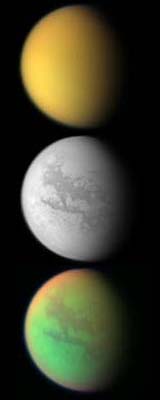
Pasadena CA (JPL) Apr 25, 2005 These three views of Titan from the Cassini spacecraft illustrate how different the same place can look in different wavelengths of light. Cassini's cameras have numerous filters that reveal features above and beneath the shroud of Titan's atmosphere. The first image, a natural color composite, is a combination of images taken through three filters that are sensitive to red, green and violet light. It shows approximately what Titan would look like to the human eye: a hazy orange globe surrounded by a tenuous, bluish haze. The orange color is due to the hydrocarbon particles which make up Titan's atmospheric haze. This obscuring haze was particularly frustrating for planetary scientists following the NASA Voyager mission encounters in 1980-81. Fortunately, Cassini is able to pierce Titan's veil at infrared wavelengths. A single view of this composite is also available here. The second, monochrome view shows what Titan looks like at 938 nanometers, a near-infrared wavelength that allows Cassini to see through the hazy atmosphere and down to the surface. The view was created by combining three separate images taken with this filter, in order to improve the visibility of surface features. The variations in brightness on the surface are real differences in the reflectivity of the materials on Titan. A single view of this composite is also available here. The third view, which is a false-color composite, was created by combining two infrared images (taken at 938 and 889 nanometers) with a visible light image (taken at 420 nanometers). Green represents areas where Cassini is able to see down to the surface. Red represents areas high in Titan's stratosphere where atmospheric methane is absorbing sunlight. Blue along the moon's outer edge represents visible violet wavelengths at which the upper atmosphere and detached hazes are better seen. A single view of this composite is also available here. A similar false-color image showing the opposite hemisphere of Titan was created from images taken during Cassini's first close flyby of the smoggy moon in October 2004. At that time, clouds could be seen near Titan's south pole, but in these more recent observations no clouds are seen. North on Titan is up and tilted 30 degrees to the right. All of these images were taken with the Cassini spacecraft wide angle camera on April 16, 2005, at distances ranging from approximately 173,000 to 168,200 kilometers (107,500 to 104,500 miles) from Titan and from a Sun-Titan-spacecraft, or phase, angle of 56 degrees. Resolution in the images approximately 10 kilometers per pixel. Community Email This Article Comment On This Article Related Links Cassini-Huygens at JPL Cassini Imaging Team SpaceDaily Search SpaceDaily Subscribe To SpaceDaily Express Explore The Ring World of Saturn and her moons Jupiter and its Moons The million outer planets of a star called Sol News Flash at Mercury
 Cassini Images Halo Around Titanic Moon Off Saturn
 Pasadena CA (SPX) Dec 27, 2005
With its thick, distended atmosphere, Titan's orange globe shines softly, encircled by a thin halo of purple light-scattering haze. |
|
|

| The content herein, unless otherwise known to be public domain, are Copyright 1995-2006 - SpaceDaily.AFP and UPI Wire Stories are copyright Agence France-Presse and United Press International. ESA PortalReports are copyright European Space Agency. All NASA sourced material is public domain. Additionalcopyrights may apply in whole or part to other bona fide parties. Advertising does not imply endorsement,agreement or approval of any opinions, statements or information provided by SpaceDaily on any Web page published or hosted by SpaceDaily. Privacy Statement |