|
 |
 |
 |
 |
 |
 |
 |
 |

 |
Cassini-Huygens Mission Celebrates Anniversary
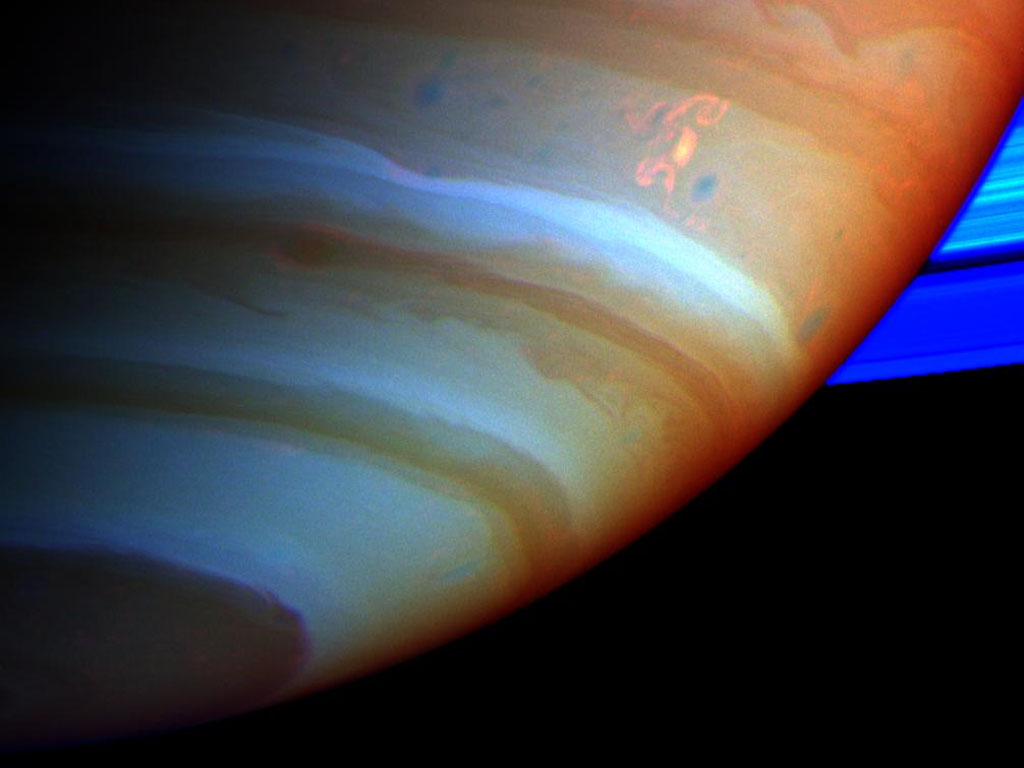
Pasadena CA (JPL) Oct 19, 2005 On the eighth anniversary of the launch of the NASA/ESA/ASI Cassini-Huygens spacecraft, the teams involved can look back at a string of remarkable discoveries. The Cassini-Huygens mission is one of the largest and most advanced planetary exploration missions ever launched. It consists of two parts - the Cassini orbiter and the Huygens probe. Cassini is currently orbiting Saturn and taking pictures and measurements of Saturn and its moons, rings and magnetosphere. Huygens successfully parachuted down through the atmosphere of Titan, Saturn's largest moon, at the start of 2005. The mission was launched on 15 October 1997 and took nearly seven years to reach Saturn, arriving on 1 July 2004. The route it took to Saturn involved fly-bys of Venus, Earth and Jupiter to help give it the energy necessary to reach Saturn. Saturn itself is the second largest planet in the Solar System. It is made of gas with a solid core and a liquid layer, and is famous for its rings which are made chiefly of ice with some rocky material acting as a colouring agent. So far, it also has 34 named moons (47 in total), including Titan that is known to have a thick nitrogen atmosphere rich in methane and is thought to bear similarities with our planet in its 'pre-biotic' stage (just before life began). Since arriving at Saturn on 1 July 2004, Cassini has taken over 35 000 images of Saturn and its magnificent rings and its amazing moons. Numerous discoveries have been made about the rings, the moons, the dynamic magnetosphere and the planet itself. Cassini's remarkable instruments provided the first glimpses of Titan's surface and gained a global picture of this hazy world. Cassini's radar provided the first pictures of Titan's surface. The orbiter also provided the first detailed global view, including possible volcanoes, rain clouds, flow features, lakes, craters and vast dune fields, as well as other puzzling terrain. A soup of complex hydrocarbons, including benzene, has been detected in Titan's atmosphere. But the highlight of the mission so far is clearly the lifting of the veil on smog-covered Titan. At around 11:30 UT, 14 January 2005, ESA's Huygens probe landed the surface of this distant world. This event makes it the only landing to take place in the outer Solar System and the furthest from Earth. The Huygens probe showed that Titan's surface has Earth-like processes and morphology, complete with evidence for methane rain, erosion, stream-like drainage channels and dry lake beds. Community Email This Article Comment On This Article Related Links SpaceDaily Search SpaceDaily Subscribe To SpaceDaily Express Explore The Ring World of Saturn and her moons Jupiter and its Moons The million outer planets of a star called Sol News Flash at Mercury
 Cassini Images Halo Around Titanic Moon Off Saturn
 Pasadena CA (SPX) Dec 27, 2005
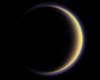
With its thick, distended atmosphere, Titan's orange globe shines softly, encircled by a thin halo of purple light-scattering haze. |
|
|

| The content herein, unless otherwise known to be public domain, are Copyright 1995-2006 - SpaceDaily.AFP and UPI Wire Stories are copyright Agence France-Presse and United Press International. ESA PortalReports are copyright European Space Agency. All NASA sourced material is public domain. Additionalcopyrights may apply in whole or part to other bona fide parties. Advertising does not imply endorsement,agreement or approval of any opinions, statements or information provided by SpaceDaily on any Web page published or hosted by SpaceDaily. Privacy Statement |