|
 |
 |
 |
 |
 |
 |
 |
 |

 |
Cash Aid Beats Supplies After Disasters: Study
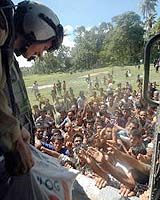
Singapore (AFP) Nov 29, 2005 Cash aid for disaster-stricken countries is more practical than relief goods because poorly planned shipments will only hamper operations, according to a study issued here Tuesday. In a report released ahead of the first anniversary of the massive December 26 earthquake and tsunami in Asia, the Economist Intelligence Unit (EIU) said "unwanted supplies can cause congestion and confusion." Moreover, local infrastructure is often destroyed, hindering communication and transportation when demand for relief is huge and immediate. It cited cases of warm clothing being sent to a tropical country, computers delivered to places with no electricity and medicine past its expiry date being given to victims. "Getting cash instead of kind from donors has the additional advantage of avoiding the stress of customs clearance," said the report funded by transport and logistics firm DHL Asia-Pacific, which takes part in relief programs. Buying locally whenever possible can also ensure that only necessary supplies are being stocked and will help inject money into a devastated economy, the EIU said. "Weeding out superfluous and unsuitable supplies not only delays disaster response but also diverts valuable personnel from the more critical task at hand," the EIU said. The suggestion to send cash instead of goods came with a warning because of the potential for corruption. "Unscrupulous people can pretend to collect money for disaster victims only to pocket it themselves," the EIU said, urging donors to give cash to "known legal institutions" and mass media donation drives. DHL Asia-Pacific chief executive Scott Price said at a media briefing that companies wanting to help in disasters should plan ahead by cementing alliances with relief agencies long before a calamity strikes. "The key is for corporations to make their relationships early with different agencies so that when something happens they're not going to the phone book to find somebody to partner with," he said. Chris Weeks, DHL's director for humanitarian affairs, added: "Corporates need to get prepared and to make their partners now when it's quiet so that when something happens they can quickly donate to the people that they trust, rather than making instant decisions." The report was based on lessons learned during relief operations in Thailand and Indonesia after the tsunami disaster, which left an estimated 217,000 people dead or missing in the Indian Ocean rim, most in Indonesia's Aceh province. Keeping airports open is critical to the supply effort, the report said. "As a rule, in a large emergency, goods should never be flown directly to the affected area, especially by parties not involved in the management and/or coordination of relief efforts," the EIU said. Aid agencies and donor companies should remember that the national government "has the sovereign responsibility to coordinate relief operations in its territory" but in case it is reluctant, pressure can be brought to bear under the leadership of the United Nations, it said. The EIU report also advised corporate donors to make it clear that all assistance will be free, otherwise relief agencies and affected governments expect firms to charge for their services and may be suspicious of their motives. "Some agencies also may feel threatened by the presence of companies in disaster-relief work, which they see as their domain," the report noted. Community Email This Article Comment On This Article Related Links SpaceDaily Search SpaceDaily Subscribe To SpaceDaily Express Bringing Order To A World Of Disasters A world of storm and tempest When the Earth Quakes
 ISRO Developing Ocean Bottom Warning Sensors
 Bangalore, India (SPX) Jan 11, 2006
Indian Space Research Organisation is developing ocean bottom sensors that will help warn tsunami strikes in advance, the Press Trust Of India reports. |
|
|

| The content herein, unless otherwise known to be public domain, are Copyright 1995-2006 - SpaceDaily.AFP and UPI Wire Stories are copyright Agence France-Presse and United Press International. ESA PortalReports are copyright European Space Agency. All NASA sourced material is public domain. Additionalcopyrights may apply in whole or part to other bona fide parties. Advertising does not imply endorsement,agreement or approval of any opinions, statements or information provided by SpaceDaily on any Web page published or hosted by SpaceDaily. Privacy Statement |