|
 |
 |
 |
 |
 |
 |
 |
 |

 |
Case builds for water on Saturn moon
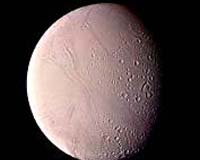
Paris (AFP) Feb 6, 2008 Astrophysicists in Germany say they can add evidence to bolster theories that water, one of the precious ingredients for life, exists on the Saturnian moon Enceladus. A tiny satellite measuring just 504 kilometres (315 miles) across, Enceladus has become one of the most fiercely debated objects in the Solar System, thanks to close-up pictures taken by the US probe Cassini. Enceladus has a brilliant white shell of ice that is untouched except for some strange-looking grooves and impacts from space rocks. Cassini revealed plumes of water vapour that gush from surface stripes near its south pole, shooting crystal jets upwards for hundreds of kilometres (miles) into space. Fuelling discussion about the origin of these strange "cryo-volcanoes" is the fact that icy particles of dust are also mixed in with the eruptions, but beguilingly travel far slower than the vapour. A team led by Juergen Schmidt of the University of Potsdam, near Berlin, say they can now answer at least this part of the mystery. Their theory is that water vapour and ice grains are blasted through funnels in the so-called tiger stripes -- and the grains, being heavier, rub against the rough sides of these holes. The friction slows the particles down, which explains why they travel at a far lower velocity in the void. For this to happen, though, liquid water would have to exist in equilibrium with ice and vapour beneath the moon's frigid crust, according to the model. One hypothesis for the cause for Enceladus's cryo-volcanoes is a phenomenon called tidal heating. The little moon suffers agonising gravitational pull from the giant Saturn and from the nearby satellites of Dione and Janus. As a result, its interior is squeezed and stretched, causing friction that causes water to warm, this theory goes. Enceladus has a surface temperature of -193 degrees Celsius (-315 degrees Fahrenheit) and the tiger stripes are -133 C (-207 F), which implies that its interior must be warmer still. Heat and water are two of the essentials for life as we know it, although anything that exists in Enceladus's presumed sub-surface ocean is likely to be microbial at best, scientists add. The new study appears on Thursday in Nature, the weekly British science journal. Community Email This Article Comment On This Article Related Links Explore The Ring World of Saturn and her moons Jupiter and its Moons The million outer planets of a star called Sol News Flash at Mercury
 The Giant Sponge Of Saturn
 Pasadena CA (JPL) Feb 06, 2008
One of Saturn's rings does housecleaning, soaking up material gushing from the fountains on Saturn's tiny ice moon Enceladus, according to new observations from the Cassini spacecraft. "Saturn's A-ring and Enceladus are separated by 100,000 kilometers (62,000 miles), yet there's a physical connection between the two," says Dr. William Farrell of NASA's Goddard Space Flight Center in Greenbelt, Md. |
|
|

| The content herein, unless otherwise known to be public domain, are Copyright 1995-2007 - SpaceDaily.AFP and UPI Wire Stories are copyright Agence France-Presse and United Press International. ESA Portal Reports are copyright European Space Agency. All NASA sourced material is public domain. Additional copyrights may apply in whole or part to other bona fide parties. Advertising does not imply endorsement,agreement or approval of any opinions, statements or information provided by SpaceDaily on any Web page published or hosted by SpaceDaily. Privacy Statement |