|
 |
 |
 |
 |
 |
 |
 |
 |

 |
Carnegie Mellon Researchers Urge Development Of Low Carbon Electricity
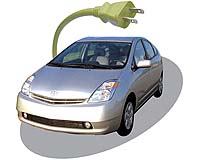
Pittsburgh PA (SPX) Apr 29, 2008 Carnegie Mellon University's Constantine Samaras and Kyle Meisterling report that plug-in hybrid electric vehicles could help reduce greenhouse gas emissions that fuel global warming, but the benefits are highly dependent on how the electricity system changes in the coming decades. In a recent article in the journal Environmental Science and Technology, the authors urge federal legislators and the electricity industry to increase the deployment of low-carbon electricity technology to power plug-in hybrid vehicles. "Plug-in hybrids represent an opportunity to reduce oil consumption, leverage next-generation biofuels and reduce greenhouse gas emissions. The types of power plants installed in the next two decades will not only affect how much we can reduce emissions from electricity, but also from vehicles if we plan on plug-in hybrids playing a substantial role," said Samaras, a Ph.D. candidate in Carnegie Mellon's departments of Engineering and Public Policy (EPP) and Civil and Environmental Engineering (CEE). "We are finding that even when the impacts from producing batteries are included, plug-in hybrids still produce slightly less greenhouse gases than hybrids that run only on gasoline. But plug-in hybrids could cut emissions in half if they are charged with electricity from low-carbon sources," said Meisterling, a Ph.D. candidate in EPP. Already, automakers have discussed plans to develop plug-in hybrids and California recently ruled that the auto industry must sell nearly 60,000 plug-ins statewide by 2014. With the price of gas heading beyond $4 per gallon, interest in alternative vehicles continues to grow. Samaras and Meisterling also say plug-ins may allow greater use of the limited supply of biofuels because they use a lot less gasoline than regular cars. The researchers found that life cycle greenhouse gas emissions from plug-in hybrids are about one-third less than a traditional gasoline-powered car. They also argue that with coal-fired electricity, emissions from plug-in hybrids are still lower than traditional cars, but are higher than ordinary hybrids. The call for increased low-carbon electricity supplies comes at a time when the U.S. electricity industry plans to build 154 new coal plants in the next 24 years to replace older plants being phased out. "The type of power plants we build today will be around for a long time. We need to begin developing policies that allow us to make big dents in oil dependence and greenhouse gas emissions," said Samaras, the recipient of a prestigious Teresa Heinz Fellowship for Environmental Research, which she is using to analyze public policies involving plug-in hybrids and low-carbon electricity. Additional research support for this project came from the National Science Foundation (NSF) through the Climate Decision Making Center and the Electric Power Research Institute, and from the Alfred P. Sloan Foundation through Carnegie Mellon's Electricity Industry Center. Community Email This Article Comment On This Article Related Links Carnegie Mellon University Car Technology at SpaceMart.com
 Germany hopes for car emissions accord with France by June
 Berlin (AFP) April 23, 2008
France and Germany are close to an agreement on reducing carbon dioxide emissions from cars, as part of broader EU goals to cut down on greenhouse gases, according to a German government source. |
|
|

| The content herein, unless otherwise known to be public domain, are Copyright 1995-2007 - SpaceDaily.AFP and UPI Wire Stories are copyright Agence France-Presse and United Press International. ESA Portal Reports are copyright European Space Agency. All NASA sourced material is public domain. Additional copyrights may apply in whole or part to other bona fide parties. Advertising does not imply endorsement,agreement or approval of any opinions, statements or information provided by SpaceDaily on any Web page published or hosted by SpaceDaily. Privacy Statement |