|
 |
 |
 |
 |
 |
 |
 |
 |

 |
Carnegie Mellon Professors Question Advice For Nuclear Attacks
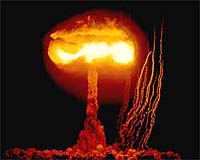
Pittsburgh PA (SPX) Apr 11, 2007 In the current Fox television adventure series, "24," a terrorist explodes a small nuclear bomb in Los Angeles. In the May 2007 issue of the journal Health Physics, Carnegie Mellon researchers Keith Florig and Baruch Fischhoff offer simple, practical advice that ordinary citizens can use when faced by such threats. Specifically, the two scientists address the following questions: whether it is worth citizens' time to stock supplies needed for a home shelter, how urgently should one seek shelter following a nearby nuclear detonation, and how long should survivors remain in a shelter after the radioactive dust settles. Carnegie Mellon's Florig, a senior research engineer and Fischhoff, a university professor, report that many families simply can't afford the government stocking guidelines; they need help to protect themselves. "A number of emergency-management organizations recommend that people stock their homes with a couple dozen categories of emergency supplies," said Florig of Carnegie Mellon's engineering and public policy department. "We calculated that it would cost about $240 per year for a typical family to maintain such a stock, including the value of storage space and the time needed to tend to it." Their research also suggests that many families who could afford to follow the stocking guidelines might think twice about whether the investment was really worth it, given the low probability that stocked supplies would actually be used in a nuclear emergency. "Government websites such as Ready.gov recommend that people take shelter or evacuate following a nuclear blast, but provide no information that might help people determine how much time they have to react before a fallout cloud arrives," said Florig. We advocate a more nuanced message with simple rules for minimizing risk based on how far people are from the blast. If you are within several miles of the blast, there will be no time to flee and you will have only minutes to seek shelter. If you are 10 miles from the blast, you will have 15 to 60 minutes to find shelter, but not enough time to reliably flee the area before the fallout arrives," said Florig. Finally, the researchers analyze how long people should remain sheltered in a contaminated area before it is riskier to stay than to evacuate. "The answer depends on how good their shelters are and how long it would take to evacuate. Those who have poor shelters, limited stores and no access to a vehicle will need the most help to escape," according to the researchers. Understanding these simple rules can help people to plan for themselves and help officials to plan for them. "More generally, I think our research illustrates how relatively simple analyses that consider citizens' circumstances can help make the best of a bad situation," said Fischhoff, a professor in Carnegie Mellon's social and decision sciences and the engineering and public policy department Community Email This Article Comment On This Article Related Links Carnegie Mellon University Learn about nuclear weapons doctrine and defense at SpaceWar.com Learn about nuclear weapons doctrine and defense at SpaceWar.com Learn about missile defense at SpaceWar.com All about missiles at SpaceWar.com Learn about the Superpowers of the 21st Century at SpaceWar.com
 Banking Breakthrough In North Korea Nuclear Impasse
 Seoul (AFP) April 11, 2007
The US State Department said authorities in Macau had unfrozen North Korean bank accounts Tuesday, paving the way for the North to start shutting down its nuclear plants. North Korea has refused to shut the Yongbyon nuclear reactor until it receives 25 million dollars in funds frozen in the Banco Delta Asia (BDA) in Macau, after Washington blacklisted the bank for allegedly laundering illicit funds. |
|
|

| The content herein, unless otherwise known to be public domain, are Copyright 1995-2006 - SpaceDaily.AFP and UPI Wire Stories are copyright Agence France-Presse and United Press International. ESA PortalReports are copyright European Space Agency. All NASA sourced material is public domain. Additionalcopyrights may apply in whole or part to other bona fide parties. Advertising does not imply endorsement,agreement or approval of any opinions, statements or information provided by SpaceDaily on any Web page published or hosted by SpaceDaily. Privacy Statement |