|
 |
 |
 |
 |
 |
 |
 |
 |

 |
Carnegie Chemists Adapt Casting Technique To Make Ordered Nanocarbons
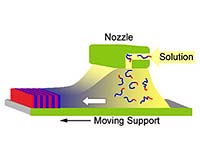
Pittsburgh PA (SPX) May 10, 2005 Carnegie Mellon University scientists have harnessed an experimental technology to produce polymer films with long-range-ordered nanostructure and easily convert them into highly ordered "nanocarbon arrays." Called zone casting, this technology could revolutionize the way industrial nanoelectronic components are made. The research findings are in press with the Journal of the American Chemical Society. "We've found that zone casting produces highly organized polymer films that could serve as templates for creating ordered nanopatterns with other materials," said Tomasz Kowalewski, an assistant professor of chemistry who is leading the Carnegie Mellon team. "The technique could, for example, help produce data storage arrays with increased density and reliability." Kowalewski also expects that zone casting could produce materials for other nanoelectronic devices, like field emission arrays. To create long-range-ordered films, Kowalewski's team used "block copolymers," which are made of long-chain molecules with distinct "blocks" of chemically different repeating units. To create self-assembling nanostructures from block copolymers, Kowalewski used molecules with blocks that naturally repel one another, like oil and water. Such copolymer strands spontaneously assume energetically favorable structures, like balls, cylinders or sheets. In recent years, scientists and engineers have sought to use these unusual structures in electronics and data storage settings. In the latter case, thin block copolymer films are used as lithographic masks to pattern ultra-high density data storage media. However, nanostructures spontaneously formed by block copolymers usually lack long-range order necessary for such applications. Thus, numerous labs are pursuing various strategies to encourage block copolymers into ordering themselves over a large scale. "Zone casting appears to be particularly well-suited to achieve this goal with a variety of block copolymers," Kowalewski said. In zone casting, a nozzle ejects a solution onto an advancing surface, or moving support. By modifying the temperature, the speed of the advancing surface and other factors, researchers already have been able to control the alignment and solidification of molecular crystals used to make organic electronic devices. The zone-casting technique was originally developed by scientists from the Polish Academy of Sciences. The Carnegie Mellon team hypothesized that a similar approach also could help establish and control long-range order of block copolymer domains. Using this technique, doctoral student Chuanbing Tang produced thin films of block copolymers made of polyacrylonitrile (PAN) and poly(n-butyl acrylate) (PBA) on a moving chip. The films consisted of alternating layers of PAN and PBA, and these layers were oriented perpendicular to the surface and to the direction of the advancing chip. Then, using a method developed earlier in the Kowalewski lab, Tang used a high-temperature treatment to convert the long-range-ordered polymer films into nanostructured carbon, while remarkably preserving the long-range order. "Zone casting offers the perfect way to direct higher order assembly so that we can pre-organize carbon precursor structures," Kowalewski said. "More important, our ongoing work indicates that we will be able to use it with other copolymer systems, forming different structures, such as hexagonally packed arrays of vertical cylinders." These latter systems are of particular interest as masks for lithographic patterning of magnetic materials for data storage arrays. The research was supported by the National Science Foundation and the Controlled Radical Polymerization Consortium at Carnegie Mellon. Community Email This Article Comment On This Article Related Links MCS SpaceDaily Search SpaceDaily Subscribe To SpaceDaily Express Nano Technology News From SpaceMart.com Computer Chip Architecture, Technology and Manufacture
 Prof Develops Cancer Nanobomb
 Newark DE (SPX) Oct 14, 2005
University of Delaware researchers are opening a new front in the war on cancer, bringing to bear new nanotechnologies for cancer detection and treatment and introducing a unique nanobomb that can literally blow up breast cancer tumors. |
|
|

| The content herein, unless otherwise known to be public domain, are Copyright 1995-2006 - SpaceDaily.AFP and UPI Wire Stories are copyright Agence France-Presse and United Press International. ESA PortalReports are copyright European Space Agency. All NASA sourced material is public domain. Additionalcopyrights may apply in whole or part to other bona fide parties. Advertising does not imply endorsement,agreement or approval of any opinions, statements or information provided by SpaceDaily on any Web page published or hosted by SpaceDaily. Privacy Statement |