|
 |
 |
 |
 |
 |
 |
 |
 |

 |
Cardiff University Experts Drill Possibly World's Smallest Hole
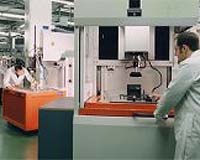
Cardiff, UK (SPX) Nov 29, 2005 Experts at Cardiff University have developed machinery so sophisticated that they can drill a hole narrower than a human hair. Such precision has potentially major benefits in medical and electronic engineering. The experts at the University's multi-award-winning Manufacturing Engineering Centre, are drilling holes as small as 22 microns (0.022 mm) in stainless steel and other materials. The human hair varies between 80 microns (0.08 mm) down to 50 microns (0.05 mm) in thickness. "The holes we are now drilling in Cardiff with the electro-discharge machining (EDM) process could be the smallest in the world," said the Centre's marketing director Frank Marsh. "The standard rods available commercially are capable of making holes of 150 microns. Although lasers are able to make small holes, these are of poorer quality when compared to the EDM process. Lasers make holes that taper, whereas EDM makes parallel or vertical holes." The process is achieved by creating a minute electrode, with a diameter of only 6 microns (0.006 mm), which was itself produced by manufacturing a highly precise wire electrode discharge grinder. "It is thought that the Japanese conceived such a grinder in 1985 and subsequently a paper stated that they have made an electrode of 5 microns (0.005 mm) in diameter, however no further evidence has emerged," said Mr Marsh The ability to produce such quality tiny holes in any conductive material represents a significant advance in mechanical engineering and will benefit designers in the medical and laboratory sciences, as well as electronic design engineers in creating smaller electronic systems which will cover a wide range of industrial and consumer industries. In the new year, the Centre's scientists will acquire new nano-technological equipment which will enable them to make even smaller holes and add surface materials of tiny thicknesses to finish optical, medical and other components. Community Email This Article Comment On This Article Related Links MEC at Cardiff University SpaceDaily Search SpaceDaily Subscribe To SpaceDaily Express Carbon Worlds - where graphite, diamond, amorphous, fullerenes meet
 Nano Interfaces With Cells
 New York (UPI) Jan 04, 2006
Coatings made with titanium and peppered with pores only nanometers or billionths of a meter wide could help interface living cells with electronics for prosthetics and other advanced devices, experts told UPI's Nano World. |
|
|

| The content herein, unless otherwise known to be public domain, are Copyright 1995-2006 - SpaceDaily.AFP and UPI Wire Stories are copyright Agence France-Presse and United Press International. ESA PortalReports are copyright European Space Agency. All NASA sourced material is public domain. Additionalcopyrights may apply in whole or part to other bona fide parties. Advertising does not imply endorsement,agreement or approval of any opinions, statements or information provided by SpaceDaily on any Web page published or hosted by SpaceDaily. Privacy Statement |