|
 |
 |
 |
 |
 |
 |
 |
 |

 |
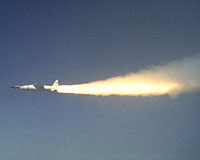
Captive Carry Rehearsal Flight Successful; Mach 10 Free Flight Next
Dryden (SPX) Sep 30, 2004 NASA aeronautics researchers are looking forward to flying the X-43A research aircraft at speeds up to 10 times the speed of sound later this fall, following a successful "captive carry" dress rehearsal flight from NASA's Dryden Flight Research Center Sept. 27. According to X-43A lead operations engineer David McAllister, who served as test director for the mission, the captive carry flight duplicated all operational functions of the planned 7,000-mph - or Mach 10 - flight and served as a training exercise for staff, except that the X-43A and its modified Pegasus booster were not released from NASA's B-52B launch aircraft and their engines were not ignited. "We have two primary purposes for doing a captive carry flight," said McAllister. "The first is to make sure that the X-43 and its booster rocket - two highly complex systems - are ready for flight. The second is to make sure we're well trained. It's a very big operation (and) we want to make sure that all those people and all those systems are ready to go." The X-43A is powered by a revolutionary air-breathing supersonic-combustion ramjet - or "scramjet" - engine. If successful, the Mach 10 flight will break all speed records for an aircraft powered by an air-breathing engine. After a review of captive-carry flight data, project engineers are expected to set a tentative date for the final X-43A flight for early November. The X-43A project is part of the Hyper-X hypersonic research program led by NASA's Aeronautics Research Mission Directorate and operated jointly by NASA's Langley Research Center, Hampton, Va., and Dryden Flight Research Center, Edwards, Calif. The program aims to demonstrate air-breathing engine technologies that promise to increase payload capacity - or reduce vehicle size for the same payload - for future hypersonic aircraft and reusable space launch vehicles. Community Email This Article Comment On This Article Related Links Hyper-X at NASA SpaceDaily Search SpaceDaily Subscribe To SpaceDaily Express Rocket Science News at Space-Travel.Com
 Successful First Test For Vega's Zefiro 9 Engine
 Paris, France(ESA) Dec 28, 2005
Flames, smoke and a deafening noise accompanied the first firing test of Vega's Zefiro 9 third-stage solid rocket motor. A first examination of the data indicates that everything went well at the test carried out yesterday at Salto de Quirra in southeast Sardinia. |
|
|

| The content herein, unless otherwise known to be public domain, are Copyright 1995-2006 - SpaceDaily.AFP and UPI Wire Stories are copyright Agence France-Presse and United Press International. ESA PortalReports are copyright European Space Agency. All NASA sourced material is public domain. Additionalcopyrights may apply in whole or part to other bona fide parties. Advertising does not imply endorsement,agreement or approval of any opinions, statements or information provided by SpaceDaily on any Web page published or hosted by SpaceDaily. Privacy Statement |