|
 |
 |
 |
 |
 |
 |
 |
 |

 |
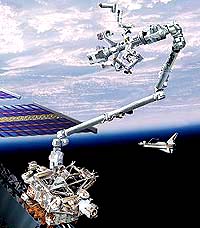
Canada Puts The Strong Arm On The International Space Station
Houston TX (SPX) Jun 06, 2005 A new capability is being added to the operation of the International Space Station. A final round of tests to commission remote control of the Station's Canadarm2 robotic arm from the ground was completed this week. The 60-foot arm was maneuvered by ground control to move in, latch onto a fixture on the exterior of the Station, release and move back out. The tests were the second and most complex remote control operations of the arm performed from the ground. The first set of tests completed earlier this year involved only basic movements. Completion of these two phases of commissioning will qualify the ground control capability to be considered for use during future Station operations. During the tests, the arm was controlled by the robotics officer in the Space Station Flight Control Room of Mission Control. Aboard the Station, Flight Engineer and NASA Station Science Officer John Phillips monitored the activity. Normally, the arm is controlled by the Station crew using a robotics workstation in the Destiny Laboratory. Other activities this week for the Expedition 11 crew included some brief additional troubleshooting of the Elektron oxygen generation unit. At the direction of Russian flight controllers, Commander Sergei Krikalev tightened a valve in the unit, attempted to pressurize the system and checked for leakage. Similar attempts may continue in the future using other Elektron components and additional monitoring. The Elektron, a system that can derive oxygen from water for use in the Station atmosphere, remains broken. The crew continues to replenish oxygen aboard the Station daily using two solid fuel oxygen generation canisters, which contain chemicals that release oxygen when heated. Plentiful supplies of oxygen remain aboard the Station, and more is set to arrive on the next supply spacecraft later this month. With reserves onboard the Station, plus those planned to arrive on future supply ships, oxygen is available for the crew until at least January 2006; even without use of the Elektron. New Elektron components and spares are planned for delivery by supply ships later this year. Phillips conducted the Miscible Fluids in Microgravity experiment this week. The experiment studies how miscible (mixable) fluids interact without the interference of gravity. Studying the interactions between molecules that make up liquids is important for improving numerous processes ranging from making plastics to manufacturing medicines. For the first part of the experiment, Phillips used a syringe to inject dyed water into honey. Investigators want to see if they merge into one stream of honey. Under normal gravity, the stream would sink. In weightlessness, the stream can be formed, but it is not known if the stream will break up like a stream of oil in water. For the second part, Phillips injected an aspherical drop of water into the honey. The process was videotaped for 30 to 40 minutes and digital images were taken for two hours. Investigators on the ground were able to watch video of the experiments, as they were conducted in space. The results will be compared to computer simulations performed by the payload developers. Next week, the crew will begin packing trash and unneeded equipment in the Progress cargo spacecraft docked to the Station. The Progress will be undocked on June 15. The next cargo vehicle will launch on June 16 and dock to the Station June 18. The crew is scheduled for light duty this weekend, including routine housekeeping tasks and family conferences. Community Email This Article Comment On This Article Related Links ISS at NASA SpaceDaily Search SpaceDaily Subscribe To SpaceDaily Express Space Station News at Space-Travel.Com
 NASA Had No Choice But To Buy Soyuz Flights
 Washington DC (SPX) Jan 09, 2006
NASA's announcement last week that it will pay Roskosmos $43.6 million for a round-trip ride to the International Space Station this spring, and an equivalent figure for an as-yet-undetermined number of future flights to the station until 2012, represents the agency's acknowledgment that it had no alternative. |
|
|

| The content herein, unless otherwise known to be public domain, are Copyright 1995-2006 - SpaceDaily.AFP and UPI Wire Stories are copyright Agence France-Presse and United Press International. ESA PortalReports are copyright European Space Agency. All NASA sourced material is public domain. Additionalcopyrights may apply in whole or part to other bona fide parties. Advertising does not imply endorsement,agreement or approval of any opinions, statements or information provided by SpaceDaily on any Web page published or hosted by SpaceDaily. Privacy Statement |