|
 |
 |
 |
 |
 |
 |
 |
 |

 |
Can The US ABM System Actually Shoot Down A Taepodong 2
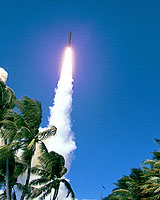
UPI Senior News Analyst Washington (UPI) Jun 23, 2006 North Korea is preparing to test launch its Taepodong 2 nuclear-capable intercontinental ballistic missile with a range of 2,100 miles to 2,700 miles. The Washington Times has reported that America's high-tech, controversial and cutting edge ballistic missile defense system was activated in response. In the past five and a half years, the Bush administration has spent at least $35 billion to deploy that system. What has it got for all that money?. A lot has certainly been done. Some, 11 ground-based midcourse interceptors, or GBIs are now deployed against exactly the kind of potential threat that North Korea's Taepodong 2 represents. Some nine of them are deployed at Fort Greeley, Alaska and another two at Vandenberg Air Force Base in California. A thoughtful study by Harold C. Hutchison published Friday on StrategyPage.com weighed the pros and cons of whether U.S. forces should seek to shoot down the Taepodong 2 when it is test-launched, possibly as early as this weekend. On the "plus" side, Hutchison notes, trying to shoot down Taepodong 2 would be a "real world" test the GBIs at Fort Greeley and Vandenberg that would be as close as they could get to a "real world" situation without an actual attack. "A successful takedown of a missile would make the American ballistic missile defense system a very real consideration for China and North Korea, rendering their arsenal of ballistic missiles obsolete," Hutchison wrote. "It would go a long way towards blunting threats to American allies in the region." However, there is also the not insignificant fact that shooting down another nation's test-fired ICBM could be interpreted as an act of war. And it would be unprecedented international behavior. No nation has ever sought to prevent another nation testing its own ICBMs by either shooting them down or taking preemptive military action against their launch pads. Also, Hutchison notes, "It might take more than one shot to hit the missile -- and the United States has a very small number of GBIs." Further, he pointed out, "Potential opponents would learn a great deal about the American missile-defense system -- and such information could make the system's task harder in a real war. The biggest question mark surrounding the GBIs, however, is how reliably they will work. Five out of the last eight tests of them proved successful. But the most recent three tests did not. In two of those tests, in December 2004 and on Feb. 14, 2005, the GBIs never launched at all. The reasons for at least two of these failures were not failures of the most ambitious high tech systems involved in the program, but simple little engineering glitches. And they occurred because the civil echelon at the Pentagon in the first Bush administration, headed by current Defense Secretary Donald Rumsfeld and his then-top deputies, Deputy Defense Secretary Paul Wolfowitz and Undersecretary of Defense for Policy Douglas Feith drove the main program contractors and the U.S. Missile Defense Agency to deploy the first wave of GBIs at Fort Greeley so fast that even the separate parts of them were not adequately component tested. Over the past two years, the MBA, headed by Gen. Henry "Trey" Obering III, has been working round the clock to upgrade its checks and maintenance programs on the interceptors. However, if the U.S. armed forces needed to shoot down a Tapeodong 2, their best bet might not be the controversial GBIs in Alaska, but using their RIM 161A anti-ballistic missiles, better-known as Standard Missile-3s, deployed on Aegis class cruisers and destroyers in the Sea of Japan and the Western Pacific Ocean. The first of those warships and ABM systems have been operational since September 2004. Hutchison in his analysis noted that the SM-3 has a range of over 300 miles and is able to hit targets up to 100 miles above sea level "with a kinetic kill vehicle that uses infra-red guidance, which destroys incoming warheads with a direct impact," traveling at almost 6,000 miles per hour. "The SM-3 is still undergoing some flight tests, but has already been deployed," Hutchison wrote. "In November, 2005, one flight test using an operational missile achieved a kill via a direct impact on a target. At least fifteen Aegis vessels in the United States Navy have been equipped to track intercontinental ballistic missiles, and at least three cruisers have been equipped to engage ballistic missiles." Writing in "The World Crisis," his personalized history of World War I, Winston Churchill who was the civilian head of Britain's Royal Navy in the opening months o that conflict, noted how at the 1915 Battle of the Dogger Bank decades of theory and millions of pounds and marks of investment by Britain and Germany in their battlecruiser fleets were put to the test in only 20 minutes of high speed action. What Churchill did not dwell upon was that the following year at the 1916 Battle of Jutland his own beloved battlecruisers proved fatally flawed. Three of them blew up within minutes of each other instantly killing 6,000 British sailors. It is likely that the arrayed ABM defenses the U.S. armed forces have already rushed into deployment would prove sufficient to handle the threat of a Taepodong 2, or even two or three of them. But no such conflict has yet been fought and uncertainties abound among prospective attackers and defenders alike. It would be better for all if the issue was never brought to the test.
Source: United Press International Community Email This Article Comment On This Article Related Links - Learn about missile defense at SpaceWar.com Learn about nuclear weapons doctrine and defense at SpaceWar.com All about missiles at SpaceWar.com Learn about the Superpowers of the 21st Century at SpaceWar.com
 Missile Defense Test Yields Successful Hit to Kill Intercept
 Washington (SPX) Jun 26, 2006
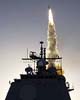
The Missile Defense Agency and the Navy conducted a successful "hit to kill" missile defense test off the island of Kauai, Hawaii. The test involved the launch of a Standard Missile 3 from the Aegis-class cruiser USS Shiloh to hit a "separating" target, meaning that the target warhead separated from its booster rocket, officials said. |
|
|

| The content herein, unless otherwise known to be public domain, are Copyright 1995-2006 - SpaceDaily.AFP and UPI Wire Stories are copyright Agence France-Presse and United Press International. ESA PortalReports are copyright European Space Agency. All NASA sourced material is public domain. Additionalcopyrights may apply in whole or part to other bona fide parties. Advertising does not imply endorsement,agreement or approval of any opinions, statements or information provided by SpaceDaily on any Web page published or hosted by SpaceDaily. Privacy Statement |