|
 |
 |
 |
 |
 |
 |
 |
 |

 |
Can Nano Tech Rebuild The Kidney
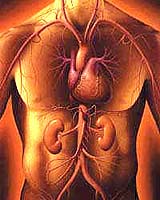
New York (UPI) Sep 08, 2005 Nanotechnological filters could lead to wearable or implantable artificial kidneys, experts told UPI's Nano World. Animal studies for artificial-kidney prototypes should begin one or two years from now, and clinical trials would follow a year or two afterward, reported scientists at Biophiltre in Burlingame, Calif., the medical-device company developing the artificial-kidney technology. Nearly 900,000 patients worldwide suffering from kidney disease require dialysis, a medical procedure mimicking the kidney's normal function of filtering waste from the blood. "About 21 percent of patients on dialysis on any year die," nephrologist Allen Nissenson, director of the University of California at Los Angeles Medical Center's dialysis services, told Nano World. "Even if they survive, they're frequently in the hospital an average of 12 to 17 days total a year." Conventional dialysis requires a customized fluid that waste from a patient's blood can diffuse into. "This requires a reservoir of fluid and a way of pumping fluid through the device, which makes a wearable system almost impossible," Nissenson explained. Biophiltre is developing a filter that mimics the function of the human kidney, which does not require such fluid. This device basically consists of two membranes. One membrane, dubbed the G, imitates the glomerulus, which in the kidney sieves all molecules out from blood, leaving behind mostly water. The other, named the T, mimics the renal tubule, which in the kidney sieves the molecules filtered out by the glomerulus to reclaim as many of the compounds that belong in blood as possible. The T membrane requires roughly 1.6 quadrillion pores, each only nanometers wide and spaced 1 to 5 nanometers apart. "Nanotechnology permits us to design each pore to selectively reclaim chemicals based on their size, shape and charge," explained Nissenson, who helped organize Biophiltre's scientific board. In computer models where the device operated 12 hours daily, it provided double the filtration of conventional dialysis. The researchers presented their findings in the journal Hemodialysis International. Initially, the device is planned as weighing roughly three to four pounds, employing roughly millimeter-thick G and T membranes and a three-and-a-half pound battery for eight to 12 hours of run time. In future versions, the device is planned to be the size of a large diver's watch and employ a nanometer-thick G and T membranes. "This is very exciting research. It could work without disrupting the patient's life as much as now," Michael Avram, chief of nephrology at Long Island College Hospital in New York, told Nano World. "There's no real competition at this time for this technology." One concern is the device cannot manufacture bicarbonate as real kidneys can to keep bodily acidity levels in check. Nissenson said patients using the device might need bicarbonate tablet or fluid supplements. Charles Choi covers research and technology for UPI. Community Email This Article Comment On This Article Related Links Biophiltre SpaceDaily Search SpaceDaily Subscribe To SpaceDaily Express Nano Technology News From SpaceMart.com Computer Chip Architecture, Technology and Manufacture
 World's Smallest Universal Material Testing System
 Evanston IL (SPX) Sep 23, 2005
The design, development and manufacturing of revolutionary products such as the automobile, airplane and computer owe a great deal of their success to the large-scale material testing systems (MTS) that have provided engineers and designers with a fundamental understanding of the mechanical behavior of various materials and structures. |
|
|

| The content herein, unless otherwise known to be public domain, are Copyright 1995-2006 - SpaceDaily.AFP and UPI Wire Stories are copyright Agence France-Presse and United Press International. ESA PortalReports are copyright European Space Agency. All NASA sourced material is public domain. Additionalcopyrights may apply in whole or part to other bona fide parties. Advertising does not imply endorsement,agreement or approval of any opinions, statements or information provided by SpaceDaily on any Web page published or hosted by SpaceDaily. Privacy Statement |