|
 |
 |
 |
 |
 |
 |
 |
 |

 |
Can Microgravity Build Better Contact Lenses
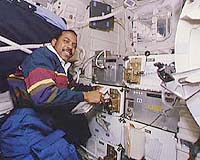
Houston TX (SPX) Feb 17, 2005 Imagine waking up in the morning to find that your vision improved overnight as you slept. While it may sound like science fiction, the technology is here today thanks to some out-of-this-world research. This advance got its start in 1993 when NASA joined forces with Paragon Vision Sciences of Mesa, Ariz., to study the production of plastic in the weightlessness of space. Free from the effects of gravity, scientists hoped their experiments would lead to a process that could improve the purity of the premium-performance plastics necessary for making contact lenses. By unleashing contact lens materials in microgravity, they believed they could better understand how polymers - the large molecules that make up plastics - are formed. During three Space Shuttle missions from 1993 to 1996, astronauts conducted experiments in the SPACEHAB pressurized research laboratory as it rested in the orbiter's cargo bay. Through this research, they were able to identify ways to form more permeable plastics, which are ideal for extended-wear contact lenses that must allow oxygen to reach the cornea. Back on Earth, the results enabled Paragon to develop an improved synthesis process that led first to HDS - Hyperpurified Delivery System - contact lenses. These gas-permeable rigid lenses do not contain water like soft contacts, are resistant to deposits and are less likely than soft contact lenses to harbor bacteria. Since they are rigid, they are also easier to handle, retain their shape over time, and provide crisper vision. These lenses were approved by the U.S. Food and Drug Administration for continuous wear of up to seven days. While the HDS lenses improve vision as they are worn, the next step in the technology was to use these materials to construct a contact that could temporarily improve vision after it had been removed from the eye. To do so, it would actually reshape the cornea while the wearer slept. Leveraging what it learned from NASA's experiments, Paragon's latest development is Corneal Refractive Therapy. The CRT lens is the first therapeutic lens design approved by the FDA for overnight use to temporarily reduce nearsightedness. Wearers reverse the procedure used with normal contacts by inserting the CRT lenses at night and removing them in the morning. The result is clear, natural vision lasting all or most of the day, eliminating the need for daytime contacts or glasses. In studies, 70 percent of the patients using the CRT lenses achieved 20/20 vision or better. More than 93 percent achieved 20/32 vision or better - exceeding driving requirements in most states. This technology now provides a non-surgical alternative for those who want to be free of glasses and contacts without undergoing laser-corrective surgery. CRT is years ahead of previous conventional methods of non-surgical reshaping, which took months to achieve results. More than 2,000 eye care practitioners nationwide are now certified to prescribe the lenses for Corneal Refractive Therapy, with tens of thousands of consumers now enjoying the benefits of this remarkable technology born in space. Community Email This Article Comment On This Article Related Links Spinoff Online: Commercialized NASA Technology SpaceDaily Search SpaceDaily Subscribe To SpaceDaily Express Space Technology News - Applications and Research
 NGC Chosen To Proceed With Developing Solid-State Laser Technology For Military Applications
 Redondo Beach CA (SPX) Jan 09, 2006
Northrop Grumman Corporation has been selected to develop "military-grade," solid-state laser technology that is expected to pave the way for the U.S. military to incorporate high-energy laser systems across all services, including ships, manned and unmanned aircraft, and ground vehicles. |
|
|

| The content herein, unless otherwise known to be public domain, are Copyright 1995-2006 - SpaceDaily.AFP and UPI Wire Stories are copyright Agence France-Presse and United Press International. ESA PortalReports are copyright European Space Agency. All NASA sourced material is public domain. Additionalcopyrights may apply in whole or part to other bona fide parties. Advertising does not imply endorsement,agreement or approval of any opinions, statements or information provided by SpaceDaily on any Web page published or hosted by SpaceDaily. Privacy Statement |