|
 |
 |
 |
 |
 |
 |
 |
 |

 |
Can An Electron Be In Two Places At The Same Time?
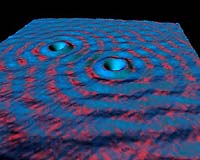
Berlin, Germany (SPX) Oct 12, 2005 In something akin to a double-slit experiment, scientists at the Fritz Haber Institute of the Max Planck Society, in co-operation with researchers from the California Institute of Technology in Pasadena, California, have shown for the first time that electrons have characteristics of both waves and particles at the same time and in virtually the push of a button can be switched back and forth between these states. The researchers provided evidence that disrupting the reflective symmetry of these molecules by introducing two different heavy isotopes, in this case N14 and N15, leads to a partial loss of coherence. The electrons partially begin to localise on one of the two, now distinguishable, atoms. The results could have implications for the building and control of "artificial molecules", which are made of semiconductor quantum dots, and are a possible component of quantum computers. (Nature, September 29, 2005). A hundred years ago, we took the first steps in recognising, at the level of elementary physical events, the dual character of nature that had been postulated in natural philosophy. Albert Einstein was the first who saw Max Planck's quantum hypothesis leading to this dual character. Einstein suggested the photon have an electromagnetic wave character, although photons had previously been considered as particles. That was the quintessence of his work on the photoelectric effect. Later in 1926, it was deBroglie that recognised that all the building blocks of nature known to us as particles - electrons, protons, etc. - behave like waves under certain conditions. In its totality, therefore, nature is dual. None of its components can only be considered as a particle or as a wave. To understand this fact, Niels Bohr introduced in 1923 the Complementarity Principle: simply put, every component in nature has a particle, as well as a wavelike character, and it depends only on the observer which character he sees at any given time. In other words, the experiment determines which characteristic one is measuring - particle or wave. His whole life long, Einstein suspected that natural characteristics actually depend on the observer. He believed that there must be a reality independent of the observer. Indeed, quantum physics has simply come to accept as a given over the years that there does not seem to be an independent reality. Physics has ceased questioning this, because experiments have confirmed it repeatedly and with a growing accuracy. The best example is Young's double-slit experiment. Coherent light is passed through a barrier with two slits. On an observation screen behind it, there is a pattern made of light and dark stripes. The experiment can be carried out not only with light, but also particles - for example, electrons. If single electrons are sent, one after the other, through the open Young double slit, then a stripe-shaped interference pattern appears on the photo plate behind it. The pattern contains no information about the route that the electron took. But if one of the two slits is closed, an image appears of the other open slit from which one can directly read the path of the electron. What this experiment does not produce, however, is a stripe pattern and situation report. For that, a molecular double slit experiment is required that is based not upon position-momentum uncertainty, but on reflective symmetry. The double-slit was voted the most beautiful experiment of all time in a 2002 poll by Physics World, published by England's Institute of Physics. Although each electron seems to go alone through one of the two slits, at the end a wavelike interference pattern is created, as if the electron split while it went through the slit, but then was subsequently re-unified. But if one of the slits is closed, or an observer sees which slit the electron went through, then it behaves like a perfectly normal particle. That particle is only at one position at one time, but not at the same time. So, depending on how the experiment is carried out, the electron is either at position A, position B, or at both at the same time. But Bohr's Complementarity Principle, which explains this ambiguity, requires that one can only observe one of the two electron manifestations at any given time - either as a wave or a particle, but not both simultaneously. This remains a certainty in every experiment, despite all the ambiguity in quantum physics. Either a system is in a state of "both/and" like a wave, or "either/or" like a particle, relating to its localisation. This is, in principle, a consequence of Heisenberg's uncertainty principle, which says that given a complementary pair of measurements - for example, position and momentum - only one can be determined exactly at the same time. Information about the other measurement is lost, proportionally. Recently there has been a set of experiments suggesting that these various manifestations of material can be "carried over into" each other - in other words, they can switch from one form to the other and, under certain conditions, back again. This set of experiments is called quantum markers and quantum erasers. Researchers have shown in the last few years that for atoms and photons - and now, electrons - "both/and" and "either/or" exist side-by-side. In other words, there is a grey zone of complementarity. There are therefore experimentally demonstrable conditions in which the material appears to be both a wave and a particle. These situations can be described with a duality relation. It can be seen as an extended Complementarity Principle for quantum physics; it can also be labelled a co-existence principle. It says that manifestations of material which would normally be mutually exclusive - e.g., local and not local, coherent and not coherent - are indeed measurable and make themselves evident, in a particular "transition area". One can speak of partial localisation and partial coherence, or partial visibility and partial differentiability. These are measurements that are connected to each other via the duality relation. In this transition area the Complementarity Principle, and the complementary dualism of nature, can be extended to be a co-existence principle, a parallel dualism. Nature has thus an ambivalent character previously unassumed. Atomic interferometry provides us with examples of this ambivalence. It was first found in 1997 in atoms, which are made from an assembly of particles. In a recent issue of Nature Max Planck researchers in Berlin, together with researchers from the California Institute of Technology in Pasadena, California, report about a molecular double-slit experiment with electrons - not assemblies of particles, like atoms. Molecules with identical, and thus reflectively symmetrical, atoms, behave like a microscopically small double-slit built by nature. Nitrogen is one such molecule. In it, each electron - also the highly localised inner electrons - stays simultaneously in both atoms. If we ionise such a molecule with a weak x-ray, we end up with a coherent - that is, wavelike - strongly coupled electron emission from both atomic sides. This is just like a double slit experiment with single electrons. For the first time, the researchers were able to show the coherent character of electron emissions from such a molecule, in this analogue to the double slit experiment. They used a weak x-ray to destabilise the innermost, and thus most strongly localised, electrons of nitrogen from the molecule, and then followed their movement in the molecular frame of reference using ion coincidence measurements. In addition, the researchers succeeded in proving something long doubted: that a disruption of the reflective symmetry of this molecule leads to a partial loss of coherence through the introduction of two different heavy isotopes, in this case N14 and N15. The electrons begin to localise partially on one of the two, now distinguishable, atoms. This is equivalent to partially marking one of the two slits in Young's double slit experiment. This is partial "which way" information, because the marking gives information about which path the electron took. The experiments were carried out by members of the working group "atomic physics" of the FHI at the synchrotron radiation laboratories BESSY in Berlin and HASYLAB at DESY in Hamburg. The measurements took place using a multi-detector array for combined electron and ion proof behind what are called undulator beam pipes, which deliver weak x-rays with a high intensity and spectral resolution. Support for the working group of four scientists and three doctoral students came from the Max Planck Society and also largely from the Federal Ministry of Education and Research, under the programme furthering research in specially chosen topics in the fundamental principles of the natural sciences. Original work: Daniel Rolles, Markus Braune, Slobodan Cvejanovic, Oliver Ge ner, Rainer Hentges, Sanja Korica, Burkhard Langer, Toralf Lischke, Georg Pr�mper, Axel Reink�ster, Jens Viefhaus, Bj�rn Zimmermann, Vincent McKoy and Uwe Becker Community Email This Article Comment On This Article Related Links SpaceDaily Search SpaceDaily Subscribe To SpaceDaily Express Understanding Time and Space
 Unified Physics Theory Explains Animals Running Flying And Swimming
 Durham NC (SPX) Jan 05, 2006
A single unifying physics theory can essentially describe how animals of every ilk, from flying insects to fish, get around, researchers at Duke University's Pratt School of Engineering and Pennsylvania State University have found. The team reports that all animals bear the same stamp of physics in their design. |
|
|

| The content herein, unless otherwise known to be public domain, are Copyright 1995-2006 - SpaceDaily.AFP and UPI Wire Stories are copyright Agence France-Presse and United Press International. ESA PortalReports are copyright European Space Agency. All NASA sourced material is public domain. Additionalcopyrights may apply in whole or part to other bona fide parties. Advertising does not imply endorsement,agreement or approval of any opinions, statements or information provided by SpaceDaily on any Web page published or hosted by SpaceDaily. Privacy Statement |