|
 |
 |
 |
 |
 |
 |
 |
 |

 |
California's Model Skies
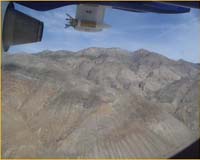
Owens Valley CA (SPX) Jun 27, 2006 Rotor winds can be devastating for aircraft. They form as air is forced over a mountain and then collapses down the other side. These sudden changes - like a wave in the sea - can be very dangerous as atmospheric chemist Dr Jim McQuaid explained: "This circulation literally kills aircraft because it changes direction very quickly. Planes are dragged up and then down, and the shock of this is too much for them." These winds pose problems for planes landing at airports including Innsbruck in Austria and the Falkland Islands. Better predictions of when these winds form will make landing and taking off in mountainous locations much safer. Researchers from the Institute for Atmospheric Science, based in the School of Earth and Environment and the UK Met. Office - through the T-REX project - have developed computer models to predict precisely when rotors will form. And a group of them took to the skies over Owen's Valley in the Sierra Nevada in three aircraft - flown by former military test pilots - to check their computer models. Their measurements are now being used not only to check the models' accuracy but to also to improve them. Dr McQuaid was one of 15 Leeds academics to join the project. He looked at how rotors carry pollutants - and the impact of the rapid changes in altitude on the chemistry of this pollution. He said: "Owen's Valley is instrumented with a vast array of equipment. It's a complex thing as the valley is controlled by a number of different agencies so it's difficult to set-up this scale of project." The T-REX project is led by Professor Stephen Mobbs - who is also director of the National Centre for Atmospheric Science, funded by the Natural Environment Research Council. Community Email This Article Comment On This Article Related Links - The Air We Breathe at TerraDaily.com
 ESA Picks SSTL To Develop Atmospheric CO2 Detector
 Guildford, England (SPX) Jun 09, 2006
ESA has awarded Surrey Satellite Technology Ltd. an 18-month contract, worth 400,000 euros ($500,000) to develop a new detector to detect levels of carbon dioxide in the atmosphere. SSTL will be prime contractor, with Sheffield and Heriot Watt Universities the United Kingdom, and Lidar Technologies Ltd. as subcontractors. |
|
|

| The content herein, unless otherwise known to be public domain, are Copyright 1995-2006 - SpaceDaily.AFP and UPI Wire Stories are copyright Agence France-Presse and United Press International. ESA PortalReports are copyright European Space Agency. All NASA sourced material is public domain. Additionalcopyrights may apply in whole or part to other bona fide parties. Advertising does not imply endorsement,agreement or approval of any opinions, statements or information provided by SpaceDaily on any Web page published or hosted by SpaceDaily. Privacy Statement |