
 |
 |
 |
 |
 |
 |
 |
 |
 |

 |
CSIRO Scientist Discovers Natural Invisible Gold
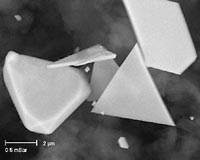
Canberra, Australia (SPX) Jun 27, 2008 The search for these natural but 'invisible' nanoparticles is important. If they can be proved to exist, the knowledge will help give us a deeper understanding of how gold can be transported and deposited by geological processes, and therefore help explorers to find new gold deposits in Australia. Now, hard evidence that gold nanoparticles have finally been seen in nature is presented in a paper published in GEOLOGY and authored by CSIRO Scientists from the Minerals Down Under National Research Flagship and CRC LEME, in collaboration with scientists from Curtin University and the University of Western Australia. Lead author, CSIRO's Dr Rob Hough, explains that the particles were discovered in Western Australia. "In the southern areas of the State, groundwater is very salty and acidic. This water dissolves primary gold and re-deposits it as pure gold crystals on fracture surfaces and in open pore spaces," he says. "On investigation of these crystals, there appeared to be a dark band across them. However, high magnification imaging showed the band was in fact, a mass of gold nanoparticles and nanoplates. These are identical to those being manufactured in laboratories around the world for their unique properties." Clays from the fracture surface were then analysed. There was no gold visible, but analysis showed the clays contained up to 59 parts-per-million of gold. The research team concluded that the nanoparticles of gold they had imaged represented the 'invisible' gold in the clay, and that this nanosized gold was common in similar environments. "The gold nanoparticles have not been identified earlier because they are transparent to electron beams and effectively invisible," Dr Hough says. "However, they are probably a common form of gold in this type of natural environment worldwide, where saline water interacts with gold deposits. They also provide the first direct observation of the nanoscale mobility of gold during weathering." With gold fetching around (AU) $950 an ounce and expected to rise, this research is good news for Australia's gold explorers. Community Email This Article Comment On This Article Share This Article With Planet Earth
Related Links CSIRO Nano Technology News From SpaceMart.com Computer Chip Architecture, Technology and Manufacture
 Nanoglassblowing Seen As Boon To Study Of Individual Molecules
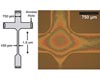 Gaithersburg MD (SPX) Jun 17, 2008
While the results may not rival the artistry of glassblowers in Europe and Latin America, researchers at the National Institute of Standards and Technology (NIST) and Cornell University have found beauty in a new fabrication technique called 'nanoglassblowing" that creates nanoscale (billionth of a meter) fluidic devices used to isolate and study single molecules in solution-including individual DNA strands. |
|
|

| The content herein, unless otherwise known to be public domain, are Copyright 1995-2007 - SpaceDaily.AFP and UPI Wire Stories are copyright Agence France-Presse and United Press International. ESA Portal Reports are copyright European Space Agency. All NASA sourced material is public domain. Additional copyrights may apply in whole or part to other bona fide parties. Advertising does not imply endorsement,agreement or approval of any opinions, statements or information provided by SpaceDaily on any Web page published or hosted by SpaceDaily. Privacy Statement |
 del.icio.us
 Digg
Digg Reddit
 YahooMyWeb
 Google
 Facebook