|
 |
 |
 |
 |
 |
 |
 |
 |

 |
COSMIC Provides Better Weather Forecasts, Climate Data
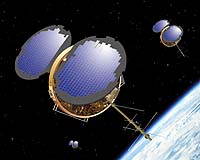
Boulder CO (SPX) Dec 13, 2006 Preliminary findings from a revolutionary satellite system launched earlier this year show that the system can boost the accuracy of forecasts of hurricane behavior, significantly improve long-range weather forecasts, and monitor climate change with unprecedented accuracy. The set of six microsatellites, launched in April, is probing the atmosphere in ways that have been impossible with previous observing systems. Dubbed COSMIC (Constellation Observing System for Meteorology, Ionosphere and Climate), the system is based on a design provided by the University Corporation for Atmospheric Research (UCAR). Initial results show that the system's unique global coverage provides unprecedented information on the atmosphere's temperature and water vapor structure. Moreover, COSMIC data can be collected above hard-to-reach locations, such as Antarctica and the remote Pacific, which could greatly enhance the global-scale monitoring needed to analyze climate change. "COSMIC may well be the most accurate, precise, and stable thermometer for measuring global and regional climate change," says UCAR president Richard Anthes. "COSMIC can see through cloud cover and gather highly accurate data through many levels of the atmosphere."
Harnessing GPS signals COSMIC works by tracking tiny changes in the speed of GPS radio signals. Using these data, scientists can now produce vertical profiles of temperature and water vapor at more than 1,000 points over Earth each day, sampling the troposphere (the atmosphere's "weather layer," closest to Earth's surface) and the stratosphere. By next year, some 2,500 profiles will be produced daily. Higher up, the system measures electron density in the ionosphere, an important observation for space-weather analysis and forecasting. In a test at the European Centre for Medium-Range Weather Forecasts (ECMWF), scientists added COSMIC data to the other weather observations used to kick-start computer forecast models. With the help of COSMIC data, stratospheric temperature forecasts over the Northern Hemisphere improve significantly. Predictions of hurricanes and typhoons also stand to benefit from COSMIC. A test involving one of the main U.S. forecast models found that the model was able to predict the birth of this year's Hurricane Ernesto two days in advance with COSMIC data. Without the data, the model was unable to predict Ernesto's formation. Tests in Taiwan this year involving Tropical Storm Bilis and other cyclones showed that COSMIC data can reduce errors in track prediction.
A boon to remote regions In Antarctica, weather forecasts that are vital to international research outposts and other activities should improve, thanks to the wealth and quality of data available through COSMIC. Radiosondes sent aloft by balloons only provide a dozen or so profiles each day above this sparsely populated region, but COSMIC provides hundreds of profiles. "With COSMIC, Antarctica is no longer a data-void region," says Ying-Hwa "Bill" Kuo, director of COSMIC in UCAR's Office of Programs. "After only a few months, we see strengths and weaknesses in the forecast models that we really have had no way of seeing before." COSMIC data will also help scientists measure and predict the density of high-altitude electrons associated with damaging solar storms. The altitudes of peak electron density have been difficult to observe and predict, because forecast models have had limited data on the vertical distribution of electrons. "The many thousands of vertical profiles that COSMIC can provide each day on electron density will be extremely useful in correcting the space weather models and their predictions," says COSMIC chief scientist Christian Rocken. The $100 million COSMIC network is the product of an agreement between the American Institute in Taiwan and the Taipei Economic and Cultural Representative Office in the United States. COSMIC is known as FORMOSAT-3 in Taiwan. U.S. support for COSMIC is provided by the National Science Foundation, NASA, the National Oceanic and Atmospheric Administration, and the Office of Naval Research. The Jet Propulsion Laboratory developed the GPS receivers used in COSMIC. Community Email This Article Comment On This Article Related Links COSMIC at UCAR Making money out of watching earth from space today Earth Observation News - Suppiliers, Technology and Application
 China To Launch 22 More Meteorological Satellites By 2020
 Beijing, China (XNA) Dec 11, 2006
China will launch another 22 meteorological satellites by 2020 after successfully putting Fengyun-2D (FY-2D), its second geostationary orbit meteorological satellite, into orbit on Friday. The 22 satellites include four more from the Fengyun-2 series, 12 from the Fengyun-3 series and six Fengyun-4 series, according to sources with the China Meteorological Administration (CMA). |
|
|

| The content herein, unless otherwise known to be public domain, are Copyright 1995-2006 - SpaceDaily.AFP and UPI Wire Stories are copyright Agence France-Presse and United Press International. ESA PortalReports are copyright European Space Agency. All NASA sourced material is public domain. Additionalcopyrights may apply in whole or part to other bona fide parties. Advertising does not imply endorsement,agreement or approval of any opinions, statements or information provided by SpaceDaily on any Web page published or hosted by SpaceDaily. Privacy Statement |