|
 |
 |
 |
 |
 |
 |
 |
 |

 |
By Looking Back, Scientists See A Bright Future For Climate Change
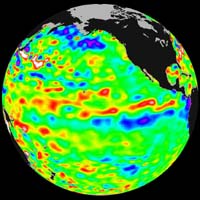
New York - Apr 15, 2004 For scientists studying climate change, the past is often a key to understanding the future. Dake Chen at Columbia University's Lamont-Doherty Earth Observatory recently used more than a century of climate data to successfully test an improved model of ENSO, the El-Ni�o/Southern Oscillation that scientists believe is behind climate change in many parts of the world. Chen and his colleagues report in the April 15 issue of the journal Nature that an improved climate model, known as LDEO5, for the first time predicted every major change in the temperature of the tropical Pacific Ocean over the past 150 years with up to two years of advance notice. In addition, their results suggest that ENSO is largely driven by internal relationships between ocean temperature and tropical winds rather than more unpredictable factors such as externally driven wind bursts, making the future of long-term climate prediction much more optimistic. "No other model has been tested in such a long-term retrospective," said Chen, a senior research scientist at the Lamont-Doherty Earth Observatory, part of The Earth Institute at Columbia University. "In a two-tiered climate forecast system, a good first-tier forecast such as this is absolutely necessary for an accurate second-tier forecast of ENSO's global impacts." El Ni�o and its opposite effect La Ni�a together make up the long-term variation in Pacific Ocean temperature that is thought to be behind events ranging from droughts in western Australia to changes in sardine catches off the coast of Peru. Together ENSO-related climate anomalies have been implicated in the deaths of tens of millions of people. Despite its importance, however, accurate predictions of ENSO have eluded scientists for decades and remain a goal of climate forecasters and public policy experts around the world. Many theories describe ENSO as a chaotic and subsequently unpredictable force that governs water temperature in the Pacific Ocean between South American and Indonesia. Large-scale fluctuations in water temperature are believed to cause changes in tropical wind patterns that not only affect global climate patterns, but that themselves govern the movement of large masses of warm surface water across thousands of miles. Chen designed LDEO5 specifically to take into account the interrelated nature of the Earth's oceans and atmosphere and, using historical climate data, found that he was able to accurately predict the onset of large El Ni�o and La Ni�a events more accurately and with greater advance notice than any previous attempt. Ultimately, Chen believes his model offers a strong case for a future when forecasters will be able to anticipate global climate change and climate-related disasters. "ENSO is by far the largest and most influential short-term climate fluctuation in the Earth's climate system," said Chen. "A better prediction of ENSO will not only benefit the tropical countries that are directly under the influence of ENSO, but will also improve our ability to manage disastrous floods and droughts in many parts of the world." Community Email This Article Comment On This Article Related Links Lamont-Doherty Earth Observatory El Nino Tracker at JPL Earth at Columbia SpaceDaily Search SpaceDaily Subscribe To SpaceDaily Express Earth Observation News - Suppiliers, Technology and Application
 New Legislation Initiated To Support Commercial Remote Sensing Industry
 New York NY (SPX) Jan 11, 2006
The importance of remotely sensed data and technologies to support natural disasters has prompted attention and action in Washington. New initiatives and legislation authorizing appropriations to the remote sensing industry will be discussed at Strategic Research Institute's U.S. Commercial Remote Sensing Industry conference, scheduled for February 9-10, 2006 in Washington D.C. |
|
|

| The content herein, unless otherwise known to be public domain, are Copyright 1995-2006 - SpaceDaily.AFP and UPI Wire Stories are copyright Agence France-Presse and United Press International. ESA PortalReports are copyright European Space Agency. All NASA sourced material is public domain. Additionalcopyrights may apply in whole or part to other bona fide parties. Advertising does not imply endorsement,agreement or approval of any opinions, statements or information provided by SpaceDaily on any Web page published or hosted by SpaceDaily. Privacy Statement |