
 |
 |
 |
 |
 |
 |
 |
 |
 |

 |
Bush signs US-India nuclear law
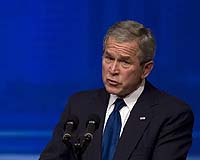
Washington (AFP) Oct 8, 2008 US President George W. Bush on Wednesday signed legislation to enact a landmark US-India civilian nuclear agreement, celebrating "the growing ties between the world's two largest democracies." "This agreement sends a signal to the world: Nations that follow the path to democracy and responsible behavior will find a friend in the United States of America," Bush said at a lavish White House signing ceremony. Indian External Affairs Minister Pranab Mukherjee will visit Washington Friday to Washington so that he and US Secretary of State Condoleezza Rice can formally sign the accord itself, the US State Department announced. Bush and Indian Prime Minister Manmohan Singh signed the deal in July 2005, touching off a difficult battle with wary lawmakers on either side and critics who warn it undermines global efforts to curb the spread of nuclear know-how. Evidently savoring the resulting diplomatic victory in the twilight of his term, the US president welcomed "the honor of signing legislation that builds on the growing ties between the world's two largest democracies." The agreement offers India access to sophisticated US technology and cheap atomic energy in return for allowing UN inspections of some of its civilian nuclear facilities -- but not military nuclear sites. Washington imposed a ban on US-Indian civilian nuclear trade after India's first nuclear test in 1974, but US officials have said a new approach is needed to help the world's largest democracy meet its booming energy needs at a time of skyrocketing oil prices and global warming fears. US lawmakers attached safeguards on preventing the spread of nuclear weapons technology before passing it overwhelmingly last week and handing the increasingly unpopular Bush administration a foreign policy victory. But critics say it still undermines global efforts to curb the spread of nuclear weapons, because India has refused to sign the international non-proliferation treaty (NPT). Bush said the accord meant India would be able to satisfy its booming economy's thirst for energy while curbing its dependence on fossil fuels linked to climate change, while the United States would gain access to India's lucrative nuclear market. "The American people are proud of our strong relationship with India. And I am confident that the friendship between our two nations will grow even closer in the years ahead," he said. Vice President Dick Cheney, US Secretary of State Condoleezza Rice, Energy Secretary Samuel Bodman, key US lawmakers who backed the agreement, and India's ambassador to Washington, Ronen Sen, attended the ceremony. Neither Democratic White House hopeful Barack Obama nor Republican rival John McCain were invited "because of their busy campaign schedules," White House spokesman Carlton Carroll said in a statement. Bush acknowledged that US relations with India, which steered an independent course from Washington during the Cold War-era, had been "strained" but said both countries were now "natural partners as we head into the 21st century." Rice and others had to lobby hard to win approval for the deal from the International Atomic Energy Agency (IAEA), the UN nuclear watchdog, and the Nuclear Suppliers Group (NSG), which controls global atomic trade. She also pushed hard for the agreement to be approved by both Houses of Congress. Singh also had a rough ride over the deal at home: The main opposition Hindu nationalists and the Communists have both slammed it as curbing India's military options and bringing the country's foreign policy too much under US influence. Community Email This Article Comment On This Article Share This Article With Planet Earth
Related Links Learn about nuclear weapons doctrine and defense at SpaceWar.com Learn about missile defense at SpaceWar.com All about missiles at SpaceWar.com Learn about the Superpowers of the 21st Century at SpaceWar.com
 'Displeased' China still engaged in Iran, NKorea nuclear talks: US
 Washington (AFP) Oct 7, 2008
China will continue to take part in multilateral talks on the Iranian and North Korean nuclear crises despite the country's objections to US plans to sell arms to Taiwan, a US state department official said on Tuesday. |
|
|

| The content herein, unless otherwise known to be public domain, are Copyright 1995-2007 - SpaceDaily.AFP and UPI Wire Stories are copyright Agence France-Presse and United Press International. ESA Portal Reports are copyright European Space Agency. All NASA sourced material is public domain. Additional copyrights may apply in whole or part to other bona fide parties. Advertising does not imply endorsement,agreement or approval of any opinions, statements or information provided by SpaceDaily on any Web page published or hosted by SpaceDaily. Privacy Statement |
 del.icio.us
 Digg
Digg Reddit
 YahooMyWeb
 Google
 Facebook