|
 |
 |
 |
 |
 |
 |
 |
 |

 |
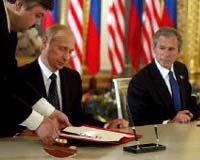
Bush, Putin Sign Nuclear Arms Treaty
Moscow (AFP) May 24, 2002 US President George W. Bush and Russian President Vladimir Putin signed a landmark nuclear disarmament treaty on Friday and hailed a new era in relations that the US leader said would lead to "incredible cooperation." The treaty, the first strategic arms reduction pact in nearly 10 years, obliges the United States and Russia to slash their nuclear arsenals by two-thirds to between 1,700 and 2,200 warheads over the next decade, bringing them down to their lowest level ever. Bush told his Russian host that the historic accord proved "that we are friends, that we are going to cast aside old doubts, old suspicions and welcome a new era in relations between your great country and our country." "I am confident that this sets the stage for incredible cooperation that we've never had before between our two countries," Bush said after the two leaders signed the Strategic Offensive Reductions Treaty in the Kremlin's ornate Andreyvsky Hall. The nuclear arms treaty and a separate strategic partnership accord signed along with a series of other cooperation accords underscored the new relationswhip between the former Cold War rivals in the wake of the September 11 attacks. Putin has wholeheartedly supported Bush in his war against terrorism and the new entente has generated benefits in almost every area. "Today we are speaking about an absolutely new quality of our relationship, regarding questions of security, questions of reducing our strategic potentials and creating a new secure world," Putin said after one-on-one talks with Bush. The only disagreement was over Moscow's nuclear cooperation with Iran, one of three countries Bush has said forms an "axis of evil" along with Iraq and North Korea, that threatens world security. Bush said he was worried that Tehran's "radical clerics" could put Russian technology to ill use but Putin sought to reassure him that Moscow's cooperation with Iran was limitied to the construction of a nuclear power plant for civilian use at Bushehr. "Our cooperation with Iran is limited to energy, it only has an economic character," Putin said, adding that Moscow was just as concerned about missile programmes in Taiwan. Despite the ongoing spat over Iran, the two presidents announced what Bush called a "major new energy partnership" to boost US private sector involvement in developing Russia's Caspian oil industry. But Bush disappointed Moscow's hopes that he would use the summit to announce the lifting of Cold-War era restricitions on trade with Russia, or the granting of market economy status. He did however pledged to persuade the US Congress to scrap the Jackson-Vanik amendment, saying "it is time" for US lawmakers to do away with the 1974 legislation designed to punish the Soviet Union for restricting the emigration of Jews. A bitter row of US poultry exports and a controversial by Washington to raise tariffs on foreign steel has stalled efforts to graduate Russia from the Jackson-Vanik amendment. "Russia is building a market economy," Bush said. "We want Russia to be a part of the world economy. We look forward to one day welcoming Russia as a member of the World trade Organisation," Bush said. The Kremlin has sought to portray Bush's visit as a reminder of how Putin has managed to drag Russia out of its post-Soviet malaise over the past two years and turn it into a trustworthy partner for the West. Putin lashed out at hardline domestic critics who regard the terms of the accord as a "humiliation" for Russia. Some arms control experts worry that the three-page treaty gives the United States too much flexibility, allowing it to store rather than destroy warheads removed from delivery vehicles as Russia had originally demanded. "We would have preferred to liquidate a certain part of nuclear potentials, but the world is a much safer place with the warheads in storage rather than still ready for use. "Any person who has ever held a weapon, any weapon -- a hunting rifle or anything else -- knows that it is much better not to have it loaded than to have it loaded, with a finger on the trigger," Putin added. But Russia's Communists and their nationalist supporters have already attacked the disarmament treaty as a humiliation for Moscow that would leave Washington with a massive advantage in nuclear and other defence potential. Community Email This Article Comment On This Article Related Links SpaceDaily Search SpaceDaily Subscribe To SpaceDaily Express Learn about nuclear weapons doctrine and defense at SpaceWar.com Learn about missile defense at SpaceWar.com All about missiles at SpaceWar.com Learn about the Superpowers of the 21st Century at SpaceWar.com
 World Powers Threaten Defiant Iran Over Nuclear Crisis
 Vienna (AFP) Jan 11, 2006
World powers threatened Iran with UN Security Council sanctions Wednesday after it resumed sensitive nuclear activities as a defiant Tehran vowed to press ahead with its disputed atomic programme. |
|
|

| The content herein, unless otherwise known to be public domain, are Copyright 1995-2006 - SpaceDaily.AFP and UPI Wire Stories are copyright Agence France-Presse and United Press International. ESA PortalReports are copyright European Space Agency. All NASA sourced material is public domain. Additionalcopyrights may apply in whole or part to other bona fide parties. Advertising does not imply endorsement,agreement or approval of any opinions, statements or information provided by SpaceDaily on any Web page published or hosted by SpaceDaily. Privacy Statement |