|
 |
 |
 |
 |
 |
 |
 |
 |

 |
Bush Presents Old Policy In New Wrapping
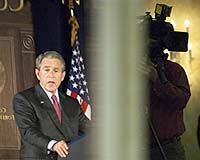
Washington (UPI) Dec 14, 2005 President George W. Bush did what he does best in his speech on Iraq Wednesday: He reaffirmed his commitment to upholding U.S. and Western democratic values and vowed he would never bow down or accept defeat in the Iraq war. As speeches go, Bush's, the fourth in a series on Iraq he has delivered over the past two weeks in and around Washington, was a good one. It showcased the president's formidable strengths as a creator and shaper of American public opinion and again reflected the meticulous focusing on key arguments effectively delivered after pain-staking preparation that have been his hallmark as an effective national leader. The president acknowledged that his assessment of intelligence on Iraq before launching the March 2003 war to topple President Saddam Hussein was mistaken, thereby bowing at last to the now-widespread recognition that not only did Iraq not have weapons of mass destruction before the war, but that intelligence to this effect was, or should have been, clearly available at the time. In making this admission, he clearly hoped to defuse what has been becoming an ever more ominous issue for him and his administration, with U.S. military deaths in Iraq now well above 2,100 and still climbing. But Bush made clear his determination to stay the course in Iraq while also making a strong case against unilaterally setting any deadline for the withdrawal of all U.S. troops from that country. However, the speech was most significant for what Bush did not say rather than what he did. The president again referred to progress in security being made in the cities of Mosul and Najaf, a subject to which he devoted a large part of his earlier address to the Council on Foreign Relations. But as in that and other previous speeches, he did not acknowledge the grim fact that security against car bombings and other insurgent terror attacks in the Iraqi capital Baghdad nd other areas has shown no significant improvement whatsoever in recent weeks. Nor did he as much as allude to worrying intelligence from many sources that Shiite militia groups are extending their effective control over overwhelmingly Shiite southern Iraq, or that the fiercely anti-American Moqtada al-Sadr and his Mahdi Army, backed by Iran, have been remorselessly consolidating their power and influence in that region. Nor did the president address the issue that, by the estimates of many U.S. military analysts and serving officers, the equivalent of one U.S. Army or Marine battalion is being ground up in Iraq every five weeks. The president once again tried to sell to the American people his conviction that the struggle against the insurgency in Iraq is the central front in the global war on terror. But he failed to acknowledge, let alone attempt any answer, to the many critics who now charge that Iraq instead has swallowed up hugely disproportionate U.S. military and financial resources and prevented them from being effectively used in the war on terror. Bush also correctly acknowledged that the Islamist insurgents in Iraq have the ambition of eventually setting up a radically anti-American and anti-Western Caliphate uniting the Muslim world from Spain to Indonesia and that they hoped to use an Iraq, cleared of U.S. forces as a stepping stone to that end. But he did not note that before Saddam was toppled, the Islamists had not the faintest prospect of getting any significant base or foothold to achieve that goal in Iraq. Bush also acknowledged that U.S. combat tactics in Iraq were evolving and changing, just as insurgency tactics were. But at no point did the president acknowledge that none of the tactical innovations or aggressive military operations U.S. forces have employed there have so far done any more than cause marginal and brief dips in the scale, rate and seriousness of insurgent operations. Nor did Bush give moderate Arab nations the hopes they nurtured after the Cairo conference of the Arab League a few weeks ago that he might invite military forces from traditional U.S. allies in the Arab world like Saudi Arabia, Morocco, Egypt or Jordan into Iraq to replace U.S. forces and help keep order there. This prospect remains anathema to the neo-conservative intellectuals who continue to dominate the thinking of the president, Vice President Dick Cheney and Defense Secretary Donald Rumsfeld. The underlying message in Bush's speech, just as it had been in the previous ones he has given in this series, is that there will be no U.S. withdrawal from Iraq and that he remains committed to total, absolute victory there. Any changes in military tactics in Iraq, or in personnel at the top levels of the Bush administration that the president makes will, therefore, only be moves towards that unchanging end. The bottom line in Bush's speech was that he contemplated no significant change whatsoever in the Iraq policies that have provoked such anger among critics and unease even among many of the administration's traditional friends. But the speech was clearly framed to present the president's position to the American people as proactive, confident and aggressive and, most of all, as innovative and adaptive to changing circumstances even, though, in reality, it was not.
Source: United Press International Community Email This Article Comment On This Article Related Links SpaceDaily Search SpaceDaily Subscribe To SpaceDaily Express Iraq: The first technology war of the 21st century
 New Year Week Of Blasts In Baghdad
 Washington (UPI) Jan 10, 2006
The New Year started not merely with a bang in Iraq but with lots of them: A wave of renewed insurgent terror bombings drove civilian casualties sky high while increased fatalities were inflicted on U.S. combat forces. |
|
|

| The content herein, unless otherwise known to be public domain, are Copyright 1995-2006 - SpaceDaily.AFP and UPI Wire Stories are copyright Agence France-Presse and United Press International. ESA PortalReports are copyright European Space Agency. All NASA sourced material is public domain. Additionalcopyrights may apply in whole or part to other bona fide parties. Advertising does not imply endorsement,agreement or approval of any opinions, statements or information provided by SpaceDaily on any Web page published or hosted by SpaceDaily. Privacy Statement |