|
 |
 |
 |
 |
 |
 |
 |
 |

 |
Bush On Iraq Strategy
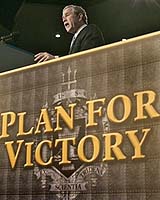
Dubai, UAE (UPI) Dec 05, 2005 Are we seeing a changing trend in the war in Iraq? Since the start of hostilities President Bush and his administration have referred to the insurgency as though it was a single, unified force fighting the U.S.-led coalition. In the past the president always spoke of the enemy, without getting too specific. But last week for the first time since the start of the war, Bush mentioned three distinct sets of insurgents currently fighting the coalition. Speaking to a group of midshipmen at the U.S. Naval Academy, the kind of audience the president prefers, Bush outlined part of his plans for winning the war, and what was needed to bring American troops back home. For the good part of an hour Bush spoke of his war plans for victory, and as he tends to do when discussing the war, he once again stressed that "progress was being made" and how important it is "to stay the course." The White House tried spinning the president's remarks as a major policy speech, yet the president's address did not contain any real policy changes or indicate that a new direction was being followed. Nor did Bush reveal how the war is being fought, nor exactly how it will be won. Nor for that matter, did the president give any indication of what is likely to change in the near future. "We will stay as long as necessary to complete the mission," Bush said, again. The president's critics however - and there were many -- say Bush's plan falls short of addressing the real issues. And it leaves Iraq vulnerable to terrorism, insurgency and civil war. "Today, President Bush failed to meet this call," Sen. Harry Reid, D-Nev., the Senate Democratic Leader said. "Instead, he recycled his tired rhetoric of 'stay the course' and once again missed the opportunity to lay out a real strategy for success in Iraq that will bring our troops safely home." Bush argues that setting an "artificial" timetable for withdrawing U.S. forces "would send a message to the rest of the world that America is weak and an unreliable ally. It would send a message to our enemies that if they wait long enough, America will cut and run and abandon its friends." There is however one point on which all sides seem to agree; that the training of Iraqi forces needs to be speeded up so that they can eventually replace American and other international forces. Even regional leaders are staring to call for the withdrawal of American troops. Addressing a conference in Dubai Gen. Shaikh Mohammad bin Rashid al-Maktoum, Crown Prince of Dubai and minister of defense of the United Arab Emirate - a close ally of the United States - called for the withdrawal of coalition forces from Iraq. "It is time for Iraq to be independent. Iraqis must take responsibility for their own security and we all have to help Iraq protect its own territory," said the UAE official. A good plan, in principle. The earlier Iraqis can take control of their own country and become masters of their own destiny, the better it would be for all. But this is where the specter of Vietnam comes back to haunt the American psyche. Forced by American public opinion to start bringing troops home, President Richard Nixon accelerated the process and the pullout from Vietnam turned out to be one of the most humiliating moments in American military history. The danger of a repeat performance in Iraq is not entirely to be ruled out. With mounting pressure to start bringing back the troops, Bush may find himself overtaken by the natural pace of events. Despite Bush's strategy to "maintain the course," the reality is that there is an election year looming in the not too distant future. What seems to be lacking from the president's plan is room for contingencies. What would happen in case Iraqi security forces failed to maintain the minimum level of security needed? What would happen if sectarian fighting were to break out between the Shiites and Sunni communities? Civil war in Iraq remains a real and present danger, a danger that will be amplified ten-fold the minute a security vacuum occurs. That, one can safely assume is precisely what the Jordanian-born terrorist Abu Musab al-Zarqawi, seems to be banking on. Until last week's speech Bush avoided going into details about who the enemy in Iraq was. But for the first time the president acknowledged that there are in fact three very different kinds of insurgent groups fighting U.S. forces in the country: he identified them as terrorists, Saddamists and rejectionists. The terrorists are made up mostly of Sunni rebels; followers of Zarqawi. These are the jihadis -- local fighters and outsider combatants who have come from all over the Arab and the Islamic world for a chance to fight the American "invaders." The second sort are the former Baathists who have gathered around them volunteers from the remnants of the Iraqi military -- among the tens of thousands of soldiers, officers and party officials cashiered by the U.S. forces soon after the fall of Baghdad. Shiakh Mohammad, incidentally, places part of the blame for what is going on in Iraq on Paul Bremer, the American pro-consul who ruled Iraq shortly after the fall of Saddam. The third kind, the 'rejectionists' are the Sunni Muslims who enjoyed special privileges but were displaced from the center of power by the defeat of Saddam's regime. Of the three, it is the terrorists who pose the most serious threat, as no negotiated deal is possible with them. They will either have to be defeated militarily, or, they will end up winning the upper hand once U.S. troops leave Iraq, and we will find Iraq following in the footsteps of Vietnam. This is a scenario that no one wants to see happen. The former Baathists and ex-Iraqi forces can eventually be reasoned with, if they are given guarantees that some of their rights and past privileges will be maintained. Talks have already been held by the Iraqi government with Sunni rebels to see if it might be feasible to bring some of them into a coalition government. And even the rejectionists can be convinced to come to a negotiated settlement with U.S. and Iraqi authorities... eventually. The unforeseen in the Bush plan are Zarqawi's fighters who will take advantage of a premature pullout of American forces - the bulk of the coalition - and in the confusion of an all-out civil war, could try to stage a takeover, giving al-Qaida its first, firm power base post Afghanistan. It is important that the final chapter of America's involvement in Iraq does not end up reading like the last chapter of America's involvement in Vietnam.
Source: United Press International Community Email This Article Comment On This Article Related Links SpaceDaily Search SpaceDaily Subscribe To SpaceDaily Express Iraq: The first technology war of the 21st century
 New Year Week Of Blasts In Baghdad
 Washington (UPI) Jan 10, 2006
The New Year started not merely with a bang in Iraq but with lots of them: A wave of renewed insurgent terror bombings drove civilian casualties sky high while increased fatalities were inflicted on U.S. combat forces. |
|
|

| The content herein, unless otherwise known to be public domain, are Copyright 1995-2006 - SpaceDaily.AFP and UPI Wire Stories are copyright Agence France-Presse and United Press International. ESA PortalReports are copyright European Space Agency. All NASA sourced material is public domain. Additionalcopyrights may apply in whole or part to other bona fide parties. Advertising does not imply endorsement,agreement or approval of any opinions, statements or information provided by SpaceDaily on any Web page published or hosted by SpaceDaily. Privacy Statement |