|
 |
 |
 |
 |
 |
 |
 |
 |

 |
Bush Backstabbed On Iraq
UPI Outside View Commentator Moscow (UPI) Dec 06, 2006 While President George W. Bush is talking with Iraqi Prime Minister Nouri al-Maliki in Amman, experts in Washington are lashing out at him for his Iraqi policy. They consider Maliki a bad choice and criticize Bush's intention to keep U.S. troops in Iraq. The president was obviously stunned by such apostasy behind his back. A memo by his National Security Advisor, Steve Hadley, that was leaked to The New York Times even compelled him to delay the meeting with Maliki for a day. Bush had much food for thought. In his secret note, Hadley made it very clear that the current Iraqi prime minister is the wrong man in the wrong place. Commenting on Maliki's "good intentions," he wrote: "But the reality on the streets of Baghdad suggests that Maliki is either ignorant of what is going on, misrepresenting his intentions, or that his capabilities are not yet sufficient to turn his good intentions into action." However, Hadley is not sure how to address the situation. He suggests that Maliki should distance himself from the fiercely anti-American Shia leader Moqtada Sadr. He also said that Washington could help Maliki form a more moderate government, which would not be so divided by religious strife. But Hadley does not seem to be so confident in the validity of his own ideas. A devout Shia, Maliki is not likely to accept either option. In the meantime, Bush must feel very unsure of himself. He is talking to a man whom his national security adviser calls uninformed and incompetent, to say the least. In effect, Hadley has criticized the prime minister for pursuing goals which run counter to U.S. interests. This is taking place at the same time as U.S. political leaders of both parties are growing more convinced that the American policy in Iraq is a total failure. No pressure from Bush can compel the Iraqi prime minister to work wonders and stop the religious massacre, which respected U.S. publications have been calling a civil war for several weeks now. This policy has to be changed, but how? Here, the U.S. president has encountered another unpleasant surprise. While he is in Amman discussing not quite what he should with not quite the right man, the basic provisions of the Iraq Study Group report have started leaking to the press. James Baker, a former U.S. secretary of state, chairs the commission, which has been considering what to do in Iraq for the last 10 months. The commission's conclusions directly contradict the president's position. Speaking at a NATO summit in Riga last week Tuesday, Bush vowed again: "There's one thing I'm not going to do, I'm not going to pull our troops off the battlefield before the mission is complete." The report, which is due to be published on Dec.r 6, recommends the opposite -- that Bush should make a public promise to start withdrawing troops from Iraq before too long -- somewhere at the beginning of the new year. The president has said more than once that a pullout would be perceived by the assortment of foes of democracy in Iraq as America's surrender, and would encourage them to unleash an even more powerful wave of terror. The Baker commission disagrees. One of its members said off the record that nothing but Bush's promise to start withdrawing troops early could create a "sense of urgency" and compel religious rivals to reach a political accord. This is doubtful. I think the president is more astute here. Even a hint of a troop withdrawal would create not so much a "sense of urgency" as a storm of cheers in the camp of Iraqi resistance. Needless to say, it is easy for Bush to insist on the completion of the mission before withdrawing the troops - his presidency ends in 2008, while U.S. Marines may be completing the mission to pacify Iraq for decades to come. But there is no other option -- a responsible power cannot let an occupied country slip into the chaos of civil war and wave goodbye. Numerous leaks from the report to the media do not make it clear to where the commission recommends that the United States withdraw 15 combat brigades -- the backbone of the occupation forces -- home or to bases on Iraqi territory. The report favors a more aggressive diplomacy. Its authors recommend that Washington directly involve Iran and Syria in resolving problems in Iraq and the rest of the Middle East. They repeat a Russian idea of many years ago by suggesting international conferences on Iraq and the Palestinian-Israeli conflict. Will Washington have to pay for the assistance of Tehran and Damascus by easing its stance on the Iranian nuclear program? James Baker and his commission leave this question unanswered. No matter what decision Bush makes, he is not likely to ignore the virtual coup that his advisors, experts, and critics have staged behind his back. Vladimir Simonov is a political commentator for the RIA Novosti news agency. This article is reprinted by permission of RIA Novosti United Press International's "Outside View" commentaries are written by outside contributors who specialize in a variety of important issues. The views expressed do not necessarily reflect those of United Press International. In the interests of creating an open forum, original submissions are invited.
Source: United Press International Community Email This Article Comment On This Article Related Links Iraq Study Group Iraq: The first technology war of the 21st century
 Benchmarks: 22,000 US Troops Injured
 Washington (UPI) Dec 06, 2006
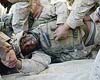
U.S. casualties in Iraq have passed another grim benchmark: Some 22,000 U.S. troops there have now been wounded since the start of the war. As of Tuesday, Dec. 6, 22,057 U.S. soldiers had been injured in Iraq since the start of military operations to topple Saddam Hussein, according to official figures issued by the U.S. Department of Defense. |
|
|

| The content herein, unless otherwise known to be public domain, are Copyright 1995-2006 - SpaceDaily.AFP and UPI Wire Stories are copyright Agence France-Presse and United Press International. ESA PortalReports are copyright European Space Agency. All NASA sourced material is public domain. Additionalcopyrights may apply in whole or part to other bona fide parties. Advertising does not imply endorsement,agreement or approval of any opinions, statements or information provided by SpaceDaily on any Web page published or hosted by SpaceDaily. Privacy Statement |