|
 |
 |
 |
 |
 |
 |
 |
 |

 |
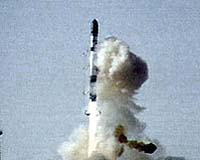
Bulava Tests Boost Russia's Confidence Against BMD
Washington (UPI) Oct 04, 2005 The Kremlin hopes that new weapons systems, including a sea-launched intercontinental ballistic missile successfully tested last week, will help restore Russia's geopolitical prominence, Cybercast News Service reported. The new-generation Bulava missile was launched Sept. 27 from a Northern Fleet strategic nuclear submarine in the White Sea, flying to a firing range on the Kamchatka peninsula, 12 time zones to the east. The solid-fuel missile can carry up to 10 individually guided nuclear warheads and has a range of up to 5,000 miles, CNS said. The Itar-Tass news agency reported Sept. 30 that the warheads of the Bulova ICBM test-launched by the St. George the Victorious nuclear-powered submarine from the Sea of Okhotsk had hit its targets in Cape Kanin Nos, in the White Sea, the Russian Defense Ministry's press-service said. "The RSM-50 submarine-based missile was launched from submerged position from a depth of about 30 meters (100 feet)," the press service said. This is the first launch of an inter-continental ballistic missile by Russia's Pacific Fleet this year. The previous missile launch from the same submarine was carried out on Nov. 2, 2004." Defense Minister Sergei Ivanov Wednesday hailed the successful test, saying the armed forces would deploy the new weapon by the end of 2007. Bulava missiles have been designed for Russia's new Borey-class nuclear submarines, two of which are being built and will be commissioned in 2006 and 2007. The test-launch came on the same day as President Vladimir Putin used a live call-in television show to tout Russia's new strategic missile systems. "We are developing and will provide the army with new high-precision strategic missile systems that are unique and unlikely to appear earlier in any other country," he said. Putin described the new missiles as "hypersonic and capable of changing course and height during flight." They would have "no rivals" and be "practically invulnerable," he added. Moscow has long stressed that it has the capability to overwhelm a U.S. missile defense umbrella due to the size of its ballistic missile arsenal. After President George W. Bush pulled out of the 1972 Antiballistic Missile Treaty in order to pursue the missile defense program, Russia announced it was no longer bound by previous agreements that prohibited missiles with multiple warheads. Having multiple warheads would reduce a weapon's vulnerability to missile defense systems which are designed to intercept and destroy one warhead at a time, CNS said. A year ago, Russia said it planned to develop nuclear weapons which other nuclear powers did not yet have and were unlikely to develop. Community Email This Article Comment On This Article Related Links SpaceDaily Search SpaceDaily Subscribe To SpaceDaily Express Learn about missile defense at SpaceWar.com Learn about nuclear weapons doctrine and defense at SpaceWar.com All about missiles at SpaceWar.com Learn about the Superpowers of the 21st Century at SpaceWar.com
 Missile Defense Program Moves Forward
 Washington DC (AFPS) Jan 12, 2006
The Missile Defense Agency continues to move forward in its efforts to protect the nation against a ballistic missile attack. The eighth ground-based interceptor missile was lowered into its underground silo at Fort Greely, Alaska, Dec. 18, 2005. |
|
|

| The content herein, unless otherwise known to be public domain, are Copyright 1995-2006 - SpaceDaily.AFP and UPI Wire Stories are copyright Agence France-Presse and United Press International. ESA PortalReports are copyright European Space Agency. All NASA sourced material is public domain. Additionalcopyrights may apply in whole or part to other bona fide parties. Advertising does not imply endorsement,agreement or approval of any opinions, statements or information provided by SpaceDaily on any Web page published or hosted by SpaceDaily. Privacy Statement |