|
 |
 |
 |
 |
 |
 |
 |
 |

 |
Built-In Eyeshade Offers Clue To Prehistoric Past
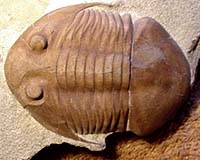
Edmonton - Sep 19, 2003 A new, rare fossil of a prehistoric sea creature bearing eyes like "twin towers" sheds light on how it lived more than 395 million years ago, says a University of Alberta researcher. Dr. Brian Chatterton, one of the world's leading experts on trilobites and a professor in the U of A's Faculty of Science, reports on the discovery of the only known complete specimen of a particular trilobite in this week's edition of the prestigious scientific journal Science. Trilobites were among the most active animals in the sea--they ran around the sea floor and occasionally burrowed in the sediment or swam around. They had eyes similar to those of their distant relatives, the insects, but they also had antennae, making it possible to see and touch the world around them. Chatterton was recently contacted by Richard Fortey of the Natural History Museum in London after a commercial dealer offered the specimen--phacopoid trilobite Erbenochile----found in Morocco, for sale. Fortey turned to Chatterton to learn exactly what and how rare the specimen was. They soon discovered that its several exaggerated and unique features made it of "more than normal interest" to paleontologists. Unlike other trilobites eyes, the giant eyes on this specimen stand up like twin towers or have extensions of their palpebral lobes that stretch outward above the eye. "These lobes would have acted like a lens shade on a camera or a baseball hat brim on humans. They prevented unwanted light from entering the lenses which would otherwise bounce around and cause a fuzziness in the image seen by the trilobite animal," said Chatterton. "These trilobites lived at a time--395 million years ago--when large predatory fishes capable of crushing shelled animals were becoming common for the first time, and perhaps acute vision allowed these trilobites to escape or hide from being eaten." Despite some suggestion that the species was nocturnal, this finding shows that the trilobite may have operated during daylight hours. Distinct and unusual features seldom appear in evolution as random occurrences without offering some practical use, said Chatterton. Since most of our knowledge of the world at the time of this trilobite is based on the fossils preserved on what was the sea floor of the ancient continental shelves, this discovery is an interesting new feature that helps us understand how some animals lived centuries ago. Community Email This Article Comment On This Article Related Links University of Alberta SpaceDaily Search SpaceDaily Subscribe To SpaceDaily Express Life Beyond Earth Lands Beyond Beyond - extra solar planets - news and science
 SETI Sets Its Sights On M Dwarfs
 Moffett Field CA (SPX) Nov 18, 2005
Scientists have been searching actively for signs of intelligent extraterrestrial civilizations for nearly half a century. Their main approach has been to point radio telescopes toward target stars and to "listen" for electronic transmissions from other worlds. |
|
|

| The content herein, unless otherwise known to be public domain, are Copyright 1995-2006 - SpaceDaily.AFP and UPI Wire Stories are copyright Agence France-Presse and United Press International. ESA PortalReports are copyright European Space Agency. All NASA sourced material is public domain. Additionalcopyrights may apply in whole or part to other bona fide parties. Advertising does not imply endorsement,agreement or approval of any opinions, statements or information provided by SpaceDaily on any Web page published or hosted by SpaceDaily. Privacy Statement |