|
 |
 |
 |
 |
 |
 |
 |
 |

 |
Bugs From The Deep May Be Window Into The Origins Of Life
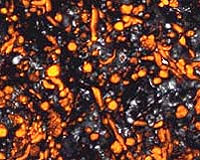
Denver - Feb 17, 2003 Simple life forms are turning up in a surprising variety of below-ground environments, potentially making up 50 percent of the Earth's biomass, scientists said today at the American Association for the Advancement of Science (AAAS) Annual Meeting. From South African gold mines, to cooled seafloor lavas, these subsurface bugs have provided clues to the potential for life on Mars, and the diversity of possible fuel sources for life, including nuclear energy and toxic waste. Life on Mars may exist in "pillow lavas," volcanic rocks that are common on and below the terrestrial seafloor, according to Martin Fisk of Oregon State University. He and his colleagues have investigated the bacteria that live inside pillow lavas on Earth, and found that the microbes seem to be getting their energy from reactions between the glass in the rock and water. Pillow lavas are likely to exist on Mars, Fisk said, and their unusual bulbous shape should make them easy to detect as researchers increase the resolution of photos taken of the planet's surface. "On Earth, microbes live in the glass of pillow lavas. Mars could host life in similar volcanic rocks, although this would require the presence of 'primary producers' -- organisms that make organic matter from chemical energy and carbon dioxide," Fisk said. "We're currently working to identify those microbes in Earth's volcanic rocks." Pillow lavas form as seawater rapidly cooled molten lava into volcanic glass. Because these glasses don't have internal crystal structures, the way minerals do, bacteria leave distinctively-shaped tracks as they bore minute holes into the glass. "I sometimes joke that if NASA could get me a pillow lava, I could tell you if anything ever lived in it," Fisk said. He noted, however, that the rock would have to be well-preserved. Life doesn't have to be from another planet in order to survive in seemingly inhospitable conditions, other speakers in the AAAS panel have discovered. Tullis Onstott of Princeton University and his colleagues have found bacterial populations within the walls of South African diamond mines, at depths between 0.8 and 3.3 kilometers. There, temperatures reach up to 60 degrees C and pressures are nearly 250 times as high as on the surface. The microbes that Onstott and his colleagues have found are unlike any living near the Earth's surface. They may even be deriving their energy from nuclear power, at least indirectly. Water plus nuclear radiation emitted from rocks, such as those in the mines produces hydrogen, oxygen, and hydrogen peroxide. The researchers have hypothesized that the bacteria may be using this hydrogen for fuel. "The deep subsurface may be the only place on Earth where communities are using nuclear power that is natural and environmentally safe," Onstott said. The bacterial species may also be ancient. New age estimates from water samples taken from the mines suggest that the water is up to 100 million years old. "Studying these unusual, primitive microorganisms helps us appreciate life's ability to take hold in a remarkable variety of environments. It may even help us understand how life evolved on Earth or other planets," Onstott said. Closer to home, Susan Brantley of Pennsylvania State University has grown bacteria on different mineral surfaces in her lab. Her goal is to understand how the microbes extract elements from their environment to sustain themselves. "Early life had to solve all the same problems" that these bacteria do, Brantley said. She thinks that some bacteria's body chemistry may incorporate elements, such as nickel, that were most accessible when life emerged on Earth. "Snapshots of the chemistry of the early Earth may be caught in these organisms," said Brantley. Research in thermal hot springs also reveals bacteria's adaptability to all kinds of environments where photosynthesis cannot take place. Everett Shock of Arizona State University studies life in hot springs such as those in Yellowstone National Park. Shock and his colleagues have identified more than a hundred possible types of metabolic reactions in which the organisms derive their energy from chemical reactions. While these include familiar reactions involving hydrogen, iron, sulfur, nitrogen, and organic compounds, they also involve more unusual elements, such as arsenic, selenium, and uranium. Other metal-reducing bacteria may have potential for use in environmental cleanup efforts, according to John Zachara of the Pacific Northwest National Laboratory. Another unsung role played by bacteria involves the formation of large deposits of methane hydrate on the seafloor. These deposits are solid under the high pressures and low temperatures at the seafloor. If that pressure were reduced or the temperature increased, however, the hydrate would likely vaporize, producing large volumes of methane, a potent greenhouse gas. Scientists have proposed that methane hydrates may have had a hand in past climate change episodes, or may be a possible fuel source. Frederick Colwell of the Idaho National Engineering and Environmental Laboratory has identified some of the microbes that make the methane in these deposits. Colwell and his colleagues are now trying to determine the rate at which these bugs produce methane, which should help researchers predict where methane hydrates are located. Community Email This Article Comment On This Article Related Links SpaceDaily Search SpaceDaily Subscribe To SpaceDaily Express Explore The Early Earth at TerraDaily.com
 Scientists Find Evidence For Crucial Root In The History Of Plant Evolution
 New Orleans - Mar 26, 2003
If ancient plants had not migrated from the shallow seas of early Earth to the barren land of the continents, life as we know it might never have emerged. And now it appears this massive floral colonization may have been spurred by a single genetic mutation that allowed primitive plants to make lignin, a chemical process that leads to the formation of a cell wall. |
|
|

| The content herein, unless otherwise known to be public domain, are Copyright 1995-2006 - SpaceDaily.AFP and UPI Wire Stories are copyright Agence France-Presse and United Press International. ESA PortalReports are copyright European Space Agency. All NASA sourced material is public domain. Additionalcopyrights may apply in whole or part to other bona fide parties. Advertising does not imply endorsement,agreement or approval of any opinions, statements or information provided by SpaceDaily on any Web page published or hosted by SpaceDaily. Privacy Statement |