|
 |
 |
 |
 |
 |
 |
 |
 |

 |
Buckyball Carbon Brings Light Into Line
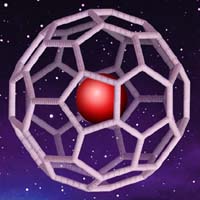
Toronto - Sep 15, 2003 Using molecules resembling 60-sided soccer balls, a joint team of researchers from the University of Toronto and Carleton University has created a new material for processing information using light. Led by U of T electrical and computer engineering professor Ted Sargent and Carleton University chemistry professor Wayne Wang, the team developed a material that combines microscopic spherical particles known as "buckyballs" with polyurethane, the polymer used as a coating on cars and furniture. The buckyballs, given the chemical notation C60, are clusters of 60 carbon atoms resembling soccer balls that are only a few nanometres in diameter. (A nanometre equals a billionth of a metre.) When the mixture of polyurethane and buckyballs is used as a thin film on a flat surface, light particles travelling though the material pick up each others' patterns. These materials have the capacity to make the delivery and processing of information in fibre-optic communications more efficient. "In our high-optical-quality films, light interacts 10-to-100 times more strongly with itself, for all wavelengths used in optical fibre communications, than in previously reported C60-based materials," says Sargent, a professor at U of T's Edward S. Rogers Sr. Department of Electrical and Computer Engineering. "We've also shown for the first time that we can meet commercial engineering requirements: the films perform well at 1550 nanometres, the wavelength used to communicate information over long distances." Light-made up of particles called photons-is widely used in fibre-optic networks to communicate trillions of bits of information each second over long distances. At the moment, these fast and free-flowing signals are difficult to harness. The new material is described in a study in the Sept. 15 issue of Applied Physics Letters. "The key to making this powerful signal-processing material was to master the chemistry of linking together the buckyballs and the polymer," says Wang, Canada Research Chair in Emerging Organic Materials at Carleton University in Ottawa. According to Sargent, the Nortel Networks-Canada Research Chair in Emerging Technologies, "this work proves that 'designer molecules' synthesized using nanotechnology can have powerful implications for future generations of computing and communications networks." Nicolle Wahl is a press officer for the University of Toronto. Community Email This Article Comment On This Article Related Links University of Toronto SpaceDaily Search SpaceDaily Subscribe To SpaceDaily Express Nano Technology News From SpaceMart.com Computer Chip Architecture, Technology and Manufacture
 Study Shows Nanoparticles Could Damage Plant Life
 Newark NJ (SPX) Nov 23, 2005
A nanoparticle commonly used in industry could have a damaging effect on plant life according to a report by an environmental scientist at New Jersey Institute of Technology (NJIT). |
|
|

| The content herein, unless otherwise known to be public domain, are Copyright 1995-2006 - SpaceDaily.AFP and UPI Wire Stories are copyright Agence France-Presse and United Press International. ESA PortalReports are copyright European Space Agency. All NASA sourced material is public domain. Additionalcopyrights may apply in whole or part to other bona fide parties. Advertising does not imply endorsement,agreement or approval of any opinions, statements or information provided by SpaceDaily on any Web page published or hosted by SpaceDaily. Privacy Statement |