|
 |
 |
 |
 |
 |
 |
 |
 |

 |
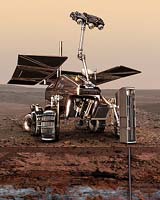
British Scientists Unveil Latest Craft To Search For Life On Mars
London, England (AFP) Jun 12, 2006 British scientists on Monday took the wraps off a prototype craft to search for signs of life on Mars, hailing it the smartest piece of equipment ever designed for exploration of the red planet. The rover, nicknamed Bridget, will contain high-tech equipment that will gather and test rock and other samples from beneath the planet's surface to determine whether life ever existed on Mars, still does or could in the future. Bridget is vying for approval in the European Space Agency's 700-million-euro ($910-million) ExoMars mission, scheduled for launch in 2011. Mike Healy, whose company is designing the six-wheel rover, told reporters the technology would build on that of the admired but ill-fated Beagle 2, a lander that disappeared after separating from ESA's Mars Express in late 2003. "The Beagle was really advanced in comparison to most of the stuff NASA is doing. This will be more advanced. This will be the most advanced thing to land on Mars," said the scientist, from space manufacturer EADS Astrium. The three-meter by 1.8-meter (9.8-feet by 5.9-feet) craft, which is expected to cost about 150 million euros ($189 million), will also cover more ground that NASA's Spirit and Opportunity exploration rovers, he added. Spirit and Opportunity have been slowly scouting Mars since landing in early 2004. "They have done maybe 10 kilometers (6.2 miles) in total," Healy said. (The actual total, according to NASA, is 14.86 kilometers, or 9.23 miles.) "The rover here (Bridget) will have done that within four to six months at the most. It's got to go to 10 sites that are up to one kilometer (0.6 miles) apart. "It won't be commanded on the ground. It will get there quicker and spend more time searching using its sophisticated technology... It will bring back more information." In addition, a "smart" sensor system has been designed to avoid the assumed pitfalls that befell Beagle 2, when scientists were unable to gauge where it landed after separation. Beagle 2's tiny payload meant it could not be fitted with this and other backup equipment. The sensors will allow adjustments to be made depending on Mars' hostile atmosphere, enabling parachutes and airbags to be deployed to allow a gentle touchdown. A model of the rover was put on display at a central London news conference to announce 1.7 million pounds (2.5 million euros, 3.1 million dollars) of investment for British research and development for ExoMars. The machine has already been put through its paces in Spain. Designers have been testing its capabilities on the barren flanks of Mount Teide volcano in Tenerife, said to have similarities to the Martian landscape. "It's got a tighter turning circle than Peter Crouch but we haven't got it to dance yet," joked Healy, a reference to the England football team's leggy striker, who has taken to dancing like a robot when he scores. Bridget is expected to weigh 150 kilos (330 pounds) with its equipment, including a unique drilling system that can bore up to two metres (6.5 feet) below Mars' surface. ExoMars is part of the ESA's Aurora Programme, set up in 2001 to explore the Solar System using innovative new technology. The mission includes an orbiter and a descent module that will land the rover onto the Martian surface. The orbiter will operate as a data relay satellite between the Earth and the vehicle on the Martian surface. Community Email This Article Comment On This Article Related Links ExoMars ESA Mars News and Information at MarsDaily.com Lunar Dreams and more
 Spirit Finds Possible Iron Meteorite
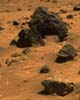 Pasadena CA (SPX) Jun 13, 2006
NASA mission controllers suspect the rock in the center foreground of this image is an iron meteorite. The panoramic camera on NASA's Mars Exploration Rover Spirit took the image during the rover's 809th Martian day, or sol, on April 12. |
|
|

| The content herein, unless otherwise known to be public domain, are Copyright 1995-2006 - SpaceDaily.AFP and UPI Wire Stories are copyright Agence France-Presse and United Press International. ESA PortalReports are copyright European Space Agency. All NASA sourced material is public domain. Additionalcopyrights may apply in whole or part to other bona fide parties. Advertising does not imply endorsement,agreement or approval of any opinions, statements or information provided by SpaceDaily on any Web page published or hosted by SpaceDaily. Privacy Statement |