|
 |
 |
 |
 |
 |
 |
 |
 |

 |
British Antarctic Scientists Get A New Mobile Home
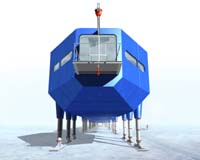
London (AFP) Oct 24, 2005 British scientists in Antarctica are to get a new mobile research base, the Department of Trade and Industry announced Monday. The innovative Halley VI Research Station will allow scientists to study environmental issues such as the ozone layer and the polar ice shelves. The 20-million-pound (29.5 million euro, 35.5 million-dollar) facility, which replaces the current Halley V Research Station, will have several modules elevated on ski-based legs which can be towed across the ice, making them easy to rearrange or relocate as the ice shifts. A series of modules designed for changing research will surround a central module used for recreation and relaxation. "The new station is essential to continue the long-running research on global change at the site," said David Sainsbury, Britain's science and innovation minister. "Antarctic discoveries, such as the ozone (layer) hole and the disintegration of ice shelves, are of vital importance if we are to protect our fragile planet Earth." The facility, which will be located 10,000 miles (16,100 kilometres) from Britain on the Brunt Ice Shelf, will be run by the British Antarctic Survey, a world leader in environmental research in the region. Community Email This Article Comment On This Article Related Links British Antarctic Survey SpaceDaily Search SpaceDaily Subscribe To SpaceDaily Express Nuclear Space Technology at Space-Travel.com
 Rewriting Glacial History In Pacific North America
 Edmonton AB (SPX) Jan 10, 2006
Although the story on glacier fluctuations in northwestern North America over the last 10,000 years has remained largely unchanged for decades, new evidence discovered by a University of Alberta researcher will rewrite that glacial history and offer clues about our climate history during the last several thousand years. |
|
|

| The content herein, unless otherwise known to be public domain, are Copyright 1995-2006 - SpaceDaily.AFP and UPI Wire Stories are copyright Agence France-Presse and United Press International. ESA PortalReports are copyright European Space Agency. All NASA sourced material is public domain. Additionalcopyrights may apply in whole or part to other bona fide parties. Advertising does not imply endorsement,agreement or approval of any opinions, statements or information provided by SpaceDaily on any Web page published or hosted by SpaceDaily. Privacy Statement |