|
 |
 |
 |
 |
 |
 |
 |
 |

 |
Britain Warns Over Re-Emerging Nuclear Threat
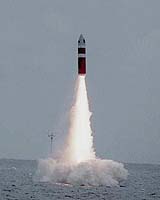
London (AFP) Jan 25, 2007 Defence Secretary Des Browne called Thursday for Britain to modernise its submarine-based nuclear deterrent, warning that a nuclear weapons threat could re-emerge. The British Labour government's nuclear renewal plans have triggered debate before a March vote in parliament, with many Labour lawmakers arguing that a deterrent is no longer needed after the end of the Cold War. "While right now there is no nuclear threat, we cannot be sure that one will not re-emerge," Browne said in a speech to academics and students at King's College, London. "There is no realistic prospect of a world without nuclear weapons in the foreseeable future." During questions afterwards, Browne warned that "many countries that are trying to acquire nuclear weapons ... are in unstable zones that will become more unstable in the future." He said Britain's nuclear weapons were designed purely as a deterrent and were not intended to be deployed in conflict, insisting politicians would only consider "using nuclear weapons in the most extreme situations of self-defence." He said Britain needed its own deterrent as "we don't want to be relying on anybody in an ever-changing world." Though some church leaders reject nuclear weapons on moral grounds, it made no sense to insist they are "inherently evil," Browne said. "The question is, given that this power exists, is it wrong for us to have it, to deter others from using it against us?," he asked. "To be consistent, any proponent of the absolutist moral argument must argue that, even were a Hitler to possess a nuclear weapon, it would be morally wrong for us to possess a counter-balancing nuclear force," he said. "Frankly, I suspect many of us think the opposite -- that it is at the very least morally permissible, maybe even morally required, for us to possess a nuclear deterrent under these circumstances," he said. Browne echoed arguments by Prime Minister Tony Blair that Britain had to act now to take the first steps towards maintaining the deterrent, because of the estimated 17 years it takes to design, build and deploy a new submarine. In December, Blair unveiled his plans to the House of Commons for replacing four nuclear submarines -- on which Trident nuclear missiles are deployed -- which will become obsolete around 2025. No decisions were needed on replacing warheads, as the lifespan of the Trident D5 missile can be extended to 2042. Nuclear weapons are a divisive issue within the Labour Party, as unilateral disarmament was a key plank of its policy at the height of the Cold War during the 1980s.
earlier related report The International Atomic Energy Agency "is aware of the case and expects formal notification from Georgian authorities soon," IAEA spokeswoman Melissa Fleming said. "Given the serious consequences of the detonation of an improvised nuclear explosive device, even small numbers of incidents involving HEU or plutonium (the two main explosive materials for atom bombs) are of very high concern," Fleming said. Both the United States and Russia have worked in recent years to convert nuclear reactors that use HEU to run on low enriched uranium that is less of a proliferation risk. The two main nuclear powers have also recycled HEU from nuclear weapons that are being retired. Fleming said however that "trafficking incidents involving nuclear material point to possible weaknesses and may be indicative of the illicit availability of larger undetected quantities." The IAEA has a data bank that lists 16 cases of incidents involving HEU or plutonium that could have been smuggled or was reported lost from 1993 to 2005. In one case from 1993, 4.4 tons of beryllium including 140 kilgrams contaminated with some 150 grams of HEU "were discovered in the storage area of a bank" in the Lithuanian capital Vilnius, according to the illicit trafficking data. In a second case in 1994, a total of 2.972 kilograms of HEU was found in St. Petersburg, Russia, when "an invidual was arrested in possession of HEU, which he had previously stolen from a nuclear facility. "The material was intended for illegal sale," the data base said. But these amounts of HEU are relatively small. A total of from 15 to 25 kilograms of HEU is normally needed to make one atomic bomb, although very high-tech weapons can use less HEU, according to experts. But the Times said the Georgia case, which is not listed on the IAEA data base, "has alarmed officials because they had thought that new security precautions had tamped down the nuclear black market that developed in the 1990s after the Soviet Union collapsed."
Source: Agence France-Presse Community Email This Article Comment On This Article Related Links Learn about nuclear weapons doctrine and defense at SpaceWar.com Learn about nuclear weapons doctrine and defense at SpaceWar.com Learn about missile defense at SpaceWar.com All about missiles at SpaceWar.com Learn about the Superpowers of the 21st Century at SpaceWar.com
 Hawks And Doves Over Iran
 Washington (UPI) Jan 24, 2007
"Cataclysmic ... Apocalyptic," said Gianfranco Fini, Italy's former deputy prime minister and foreign minister, and leader of the National Alliance. He had just been asked for the likely reaction of America's NATO allies in the event of Israeli and/or U.S. air strikes against Iran's nuclear facilities. |
|
|

| The content herein, unless otherwise known to be public domain, are Copyright 1995-2006 - SpaceDaily.AFP and UPI Wire Stories are copyright Agence France-Presse and United Press International. ESA PortalReports are copyright European Space Agency. All NASA sourced material is public domain. Additionalcopyrights may apply in whole or part to other bona fide parties. Advertising does not imply endorsement,agreement or approval of any opinions, statements or information provided by SpaceDaily on any Web page published or hosted by SpaceDaily. Privacy Statement |