|
 |
 |
 |
 |
 |
 |
 |
 |

 |
Bringing eHealth To Europe Via Satellite
Paris (ESA) Dec 17, 2002 Sitting in a doctor's waiting room is not most people's idea of fun, so a recent conference in Bruges, Belgium, on Delivering eHealth across Europe, has good news for Europeans -- visiting a doctor's surgery may become a rare event. Present at the 3rd Annual Conference of the European Health Telematics Association were representatives of the European Union, the International Telecommunications Union and ESA. These organisations, together with the World Health Organisation, make up the Telemedicine Alliance, an 18-month European project to examine the use of eHealth: health care that makes use of electronic means of telecommunication such as phones, television, computers and satellites. Satellites and the European Space Agency may not be the first thing that comes to mind when thinking of improving health, yet there are many ways in which ESA and its programmes contribute to improving health care.
Less time spent in waiting rooms Many visits to doctors and hospitals are for routine checkups or just to collect a repeat prescription. With eHealth many of these services could be done or requested from home. Household electronic equipment, such as phones, televisions, remote controls and computers, can be used to take and transmit data such as temperature, blood pressure and sugar level to a central medical centre for examination and checking against existing health records. For instance some mobile phones already have electrodes on the back enabling them to be used as an electrocardiogram. Prescriptions could also be sent electronically to local pharmacists ready for immediate collection. Imagine the time saved and the queues avoided. Even more important, by cutting down on the number of routine visits and the paperwork that has become the bane of modern medicine, more time, money and resources could be dedicated to helping the seriously ill.
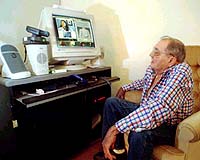
Helping the old and the infirm eHealth can help this section of society -- and those who care for them -- by enabling patients to transmit health data without having to leave their home. Specialist medical centres, with electronic access to patients' medical records, will then immediately check the data and ensure that all is well. Patients intimidated by electronic equipment can be personally guided through the different steps by phone or through monitors. This will ensure that the service is 'user friendly' and could offer more frequent contact with patients unable to leave their homes.
Intensive care for those who need it
Medical care wherever you are
ESA and the Telemedicine Alliance Community Email This Article Comment On This Article Related Links EU e-health EHTEL WHO ITU SpaceDaily Search SpaceDaily Subscribe To SpaceDaily Express Space Medicine Technology and Systems
 Secrets Of A Salty Survivor
 Huntsville AL (SPX) Sep 13, 2004
You can learn a lot from a microbe. Right now, a tiny critter from the Dead Sea is teaching scientists new things about biotechnology, cancer, possible life on other worlds. And that's just for starters: |
|
|

| The content herein, unless otherwise known to be public domain, are Copyright 1995-2006 - SpaceDaily.AFP and UPI Wire Stories are copyright Agence France-Presse and United Press International. ESA PortalReports are copyright European Space Agency. All NASA sourced material is public domain. Additionalcopyrights may apply in whole or part to other bona fide parties. Advertising does not imply endorsement,agreement or approval of any opinions, statements or information provided by SpaceDaily on any Web page published or hosted by SpaceDaily. Privacy Statement |