|
 |
 |
 |
 |
 |
 |
 |
 |

 |
Bright Light Yields Unusual Vibes
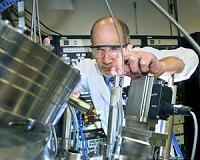
Montreal - Mar 29, 2004 By bombarding very thin slices of several copper/oxygen compounds, called cuprates, with very bright, short-lived pulses of light, Ivan Bozovic, a physicist at the U.S. Department of Energy's Brookhaven National Laboratory, and his collaborators have discovered an unusual property of the materials: After absorbing the light energy, they emit it as long-lived sound waves, as opposed to heat energy. This result may open up a new field of study on cuprates -- materials already used in wireless communications and under investigation for other applications in the electronics industry. As the light pulses strike each film, illuminating an area only about a thousandth of a millimeter across, they transfer their energy to the film's atoms. In response, the atoms vibrate, and tiny sound wave "packets," called phonons, spread through the sample. Bozovic observes that, mysteriously, these emitted sound waves do not die out quickly, as they do with other materials. Instead, the atoms oscillate many times before dissipating the absorbed energy. "This is very unusual, as it seems that the atoms find it hard to convert these oscillations into ordinary thermal energy (heat)," said Bozovic. Through further studies, Bozovic hopes to learn more about this phenomenon, the first step toward finding possible applications for it. For example, this work could contribute to the development of a phaser, a laser-like device that emits phonons instead of light. "Much more research needs to be done," Bozovic said. "We don't know yet how this property might be useful. However, I have little doubt that the phaser would be a very useful scientific tool for a broad new class of experiments," Bozovic said. Bozovic will present his work at 1:03 p.m. on Friday, March 26, in room 517A, during the "Excitation in Strongly Correlated Materials II" session. This research is funded by the Air Force Office of Scientific Research, the National Science Foundation, and a Laboratory Directed Research and Development grant from the U.S. Department of Energy's Los Alamos National Laboratory, where part of the work was performed. Community Email This Article Comment On This Article Related Links Brookhaven National Laboratory SpaceDaily Search SpaceDaily Subscribe To SpaceDaily Express Space Technology News - Applications and Research
 NGC Chosen To Proceed With Developing Solid-State Laser Technology For Military Applications
 Redondo Beach CA (SPX) Jan 09, 2006
Northrop Grumman Corporation has been selected to develop "military-grade," solid-state laser technology that is expected to pave the way for the U.S. military to incorporate high-energy laser systems across all services, including ships, manned and unmanned aircraft, and ground vehicles. |
|
|

| The content herein, unless otherwise known to be public domain, are Copyright 1995-2006 - SpaceDaily.AFP and UPI Wire Stories are copyright Agence France-Presse and United Press International. ESA PortalReports are copyright European Space Agency. All NASA sourced material is public domain. Additionalcopyrights may apply in whole or part to other bona fide parties. Advertising does not imply endorsement,agreement or approval of any opinions, statements or information provided by SpaceDaily on any Web page published or hosted by SpaceDaily. Privacy Statement |