|
 |
 |
 |
 |
 |
 |
 |
 |

 |
Breakthrough Chip Delivers Better Digital Pictures For Less Power
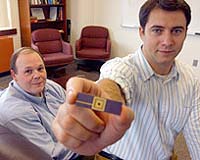
Rochester NY (SPX) Dec 09, 2005 The next advance in cameras is becoming a reality at the University of Rochester. A pair of newly patented technologies may soon enable power&endash;hungry imaging chips to use just a fraction of the energy used today and capture better images to boot all while enabling cameras to shrink to the size of a shirt button and run for years on a single battery. Placed in a home, they could wirelessly provide images to a security company when an alarm is tripped, or even allow mapping software like Google's to zoom in to real-time images at street level. The enormous reduction in power consumption and increase in computing power can also bring cell-phone video calls closer to fruition. The team of Mark Bocko, professor of electrical and computer engineering, and Zeljko Ignjatovic, assistant professor of electrical and computer engineering, has designed a prototype chip that can digitize an image right at each pixel, and they are working now to incorporate a second technology that will compress the image with far fewer computations than the best current compression techniques. "These two technologies may work together or separately to greatly reduce the energy cost of capturing a digital image," says Bocko. "One is evolutionary in that it pushes current technology further. The second may prove to be revolutionary because it's an entirely new way of thinking about capturing an image in the first place." The first technology being developed integrates an oversampling "sigma-delta" analog-to-digital converter at each pixel location in a CMOS sensor. "CMOS" is a common semiconductor fabrication process used in most chips manufactured today. Previous attempts to do this on-pixel conversion have required far too many transistors, leaving too little area to collect light. The new designs use as few as three transistors per pixel, reserving nearly half of the pixel area for light collection. First tests on the chip show that at video rates of 30 frames per second it uses just 0.88 nanowatts per pixel�50 times less than the industry's previous best. It also trounces conventional chips in dynamic range, which is the difference between the dimmest and brightest light it can record. Existing CMOS sensors can record light 1,000 times brighter than their dimmest detectable light, a dynamic range of 1:1,000, while the Rochester technology already demonstrates a dynamic range of 1:100,000. Traditional image sensors use an array of light-sensitive diodes to detect incoming light, and transistors located at each photodiode to amplify and transmit the signal to an analog-to-digital converter located outside of the photodiode array. Other designs can convert the signal to digital at the pixel site, but require high precision transistors, which take up considerable chip space at each pixel and reduce the amount of surface area on the chip devoted to receiving light. The new design not only uses smaller transistors at each pixel, and thus can allow more light to be detected, but the transistors can be scaled down in size without diminishing the sensor performance as advances in semiconductor fabrication technologies allow the size of transistors to shrink. This means that much denser, higher-resolution chips can be developed without the prohibitive problems of the existing sensor designs. When transistors are reduced in size, they also become faster, allowing incoming light to be sampled more frequently and accurately. What makes Bocko and Ignjatovic's method work so elegantly is its feedback design. Traditional CMOS image detectors apply a voltage to charge up a photodiode, and incoming light triggers a release of some of that charge. An amplifying transistor then checks the remaining voltage on the diode, and the diode is recharged again. Bocko and Ignjatovic's design also begins with a charged photodiode that discharges when light reaches it, but the discharge is then measured against a one/zero threshold and the resulting bit is delivered off the chip. If the result of a measurement is a one, then a packet of charge is fed back to the diode, effectively recharging it. The design also uses significantly less power than existing sensor designs, which is especially important in smaller devices like cell phones and digital cameras where battery size is restricted. The second advance has taken many researchers by surprise. Called "Focal Plane Image Compression," Bocko and Ignjatovic have figured out a way to arrange photodiodes on an imaging chip so that compressing the resulting image demands as little as 1 percent of the computing power usually needed. Normally, the light-detecting diodes on a chip are arranged in a regular grid�say 1,000 pixels by 1,000 pixels. A picture is snapped and each diode records the light hitting it. A computer in the camera then runs complex computations to compress the image so that instead of taking up 10 hefty megabytes, it might only take up 100 kilobytes. The common picture type "JPEG," used on the Web and on many cameras and phones, is an example of this. This compression, unfortunately, takes a tremendous amount of computing power, and hence battery power. Ignjatovic and Bocko of the Department of Electrical and Computer Engineering, came up with a way to make the physical layout of the light-sensitive diodes simplify the computation. The normal way to perform compression includes a computation called the discrete cosine transform, which checks how much a segment of an image resembles a series of cosine waves. Both the image and the cosine waves are sampled at regular intervals and the transform requires that the image and cosine wave samples be multiplied together and added. Since the cosine wave samples can have a value anywhere between -1and +1, the computation requires multiplication by non-integers, which demands the bulk of the computing power. But Ignjatovic and Bocko have laid out the pixels to lie at the peaks of cosine waves resulting in a non-uniformly distributed array, instead of an evenly spaced one. By using this trick, the amount of computation required to compress the image is slashed by nearly five-fold. Since each pixel is positioned exactly where each cosine wave has a peak where the cosine value is "one," multiplying by one is unnecessary. With no multiplication and only a little addition, the processor uses less power. The team members are now looking to build a prototype chip that incorporates both technologies into a single unit to see how much real-world processing power the designs will save. They plan to integrate the technology into wireless security cameras at first. "Wireless security cameras offer the perfect proving ground for these technologies," says Bocko. "These cameras need to capture, compress, and transmit high quality images as quickly as they can without consuming precious battery power. As we develop the chips further, we'll look more into consumer cameras and cell phones to see how much battery and processing power we can save them as well." Community Email This Article Comment On This Article Related Links University of Rochester SpaceDaily Search SpaceDaily Subscribe To SpaceDaily Express Computer Chip Architecture, Technology and Manufacture Nano Technology News From SpaceMart.com
 Scientists Discover How To Flip A Molecular Switch
 Houston TX (SPX) Nov 20, 2005
A means for controlling single-molecule switches by engineering their design and surrounding environment has been developed by a research team led by scientists at Penn State, Rice University, and the University of Oregon. |
|
|

| The content herein, unless otherwise known to be public domain, are Copyright 1995-2006 - SpaceDaily.AFP and UPI Wire Stories are copyright Agence France-Presse and United Press International. ESA PortalReports are copyright European Space Agency. All NASA sourced material is public domain. Additionalcopyrights may apply in whole or part to other bona fide parties. Advertising does not imply endorsement,agreement or approval of any opinions, statements or information provided by SpaceDaily on any Web page published or hosted by SpaceDaily. Privacy Statement |