|
 |
 |
 |
 |
 |
 |
 |
 |

 |
Brain-Imaging Cap Under Study For Space And Earth Use
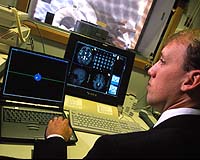
Houston - May 15, 2002 A lightweight, imaging cap being designed to assess brain function may go where no MRI has gone before. "On extended space missions, there will be a need to assess brain function as it relates to performance of high-level tasks and in the event of possible illness or injury," said Dr. Jeffrey Sutton, director of the National Space Biomedical Research Institute (NSBRI) and leader of its smart medical systems team. "This portable technology will be beneficial on Earth for assessing, diagnosing and monitoring treatment in brain disorders, such as strokes and seizures." The device utilizes diffuse optical tomography (DOT), a technique using near-infrared light and detectors to record brain activity. The light shines through the skull into the brain and records regional differences in blood flow and oxygen levels. These differences are then analyzed to reveal areas of brain activity. "Study participants at the Massachusetts General Hospital are being evaluated doing relatively simple tasks, such as hand movements, under normal and sleep-deprived conditions," said Sutton, an associate professor in the Harvard University - Massachusetts Institute of Technology Division of Health Sciences and Technology. "We'll also test it on patients experiencing changes in intracranial pressure, a condition which may be found in space." Sutton's lab, in collaboration with the MGH Photon Migration Lab, wants to see how well the imaging cap performs relative to functional magnetic resonance imaging (fMRI), the current standard for measuring brain activity non-invasively. The two techniques, fMRI and DOT, are compatible allowing both tests to be run on a participant simultaneously. "We will be able to overlay the images taken from both tests, compare the results and validate DOT's accuracy," Sutton said. "Although we know fMRI has better spatial resolution, the imaging cap is portable, lightweight, less confining and would allow astronauts or patients to move around during assessments." For its potential use in space, Sutton's group is focusing on the device's ability to detect brain function associated with performance of high-level tasks in real-life settings. Another feature is the system's potential for real-time evaluation of neurobehavioral problems, headaches, head trauma and changes in intracranial pressure. In addition to evaluating the imaging cap during simple motor tasks, a simulated space-docking task is being developed in collaboration with NASA flight surgeons. "It is simpler than an actual docking but will allow us to look at accuracy, reaction time, decision-making and overall performance under various conditions," Sutton said. "With the docking task and brain-imaging cap, we hope to develop an objective early-warning system that could avert a potential problem in space." The group is also developing the computer systems that would allow automated interpretation of data from the imaging cap. This function would be necessary in space to avoid lost time transmitting data to Earth for evaluation and also would be beneficial for Earth-based use in physician's clinics. "Just like automated interpretation of electrocardiograms, this in-office brain function assessment could enhance a physician's ability to diagnose a problem and take the appropriate action," he said. This device and others being developed by the NSBRI smart medicine team will improve delivery of medical care in space, however Sutton feels the first benefits will be realized on Earth in the assessment, treatment and monitoring of pediatric and adult patients. Community Email This Article Comment On This Article Related Links NSBRI SpaceDaily Search SpaceDaily Subscribe To SpaceDaily Express Space Tourism, Space Transport and Space Exploration News
 Spicing Up Space Meals
 Los Angeles CA (SPX) Jan 04, 2006
Since its launch a year and half ago, Minimus.biz has quickly become the place to go for individual and travel size items. Last week, NASA came to Minimus.biz and purchased several different travel size condiments to send with the astronauts to the International Space Station. |
|
|

| The content herein, unless otherwise known to be public domain, are Copyright 1995-2006 - SpaceDaily.AFP and UPI Wire Stories are copyright Agence France-Presse and United Press International. ESA PortalReports are copyright European Space Agency. All NASA sourced material is public domain. Additionalcopyrights may apply in whole or part to other bona fide parties. Advertising does not imply endorsement,agreement or approval of any opinions, statements or information provided by SpaceDaily on any Web page published or hosted by SpaceDaily. Privacy Statement |