|
 |
 |
 |
 |
 |
 |
 |
 |

 |
Born Under The Sun: UV Light And The Origin Of Life
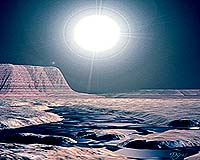
London - Jun 02, 2003 Early evolution of life as we know it may have depended on DNA's ability to absorb UV light. This insight into the early moments of life on Earth comes from research published today in the journal BMC Evolutionary Biology. The research fills in one of the major gaps in our understanding about the origins of life: how single molecules were able to join together to create the self-replicating long chain molecules of RNA, the precursors of DNA. It "sheds new light on the earliest steps of evolution," write Armen Mulkidjanian and his colleagues from Osnabr�ck University, Germany and National Institutes of Health, USA. With no ozone layer the primordial Earth was a hostile place. This was especially true for long-chain molecules that would be broken up by UV radiation, which was at 100 times today's level. Most existing theories about how life evolved involve hiding the first life forms away from the light. Instead, Mulkidjanian and his colleagues have investigated the idea that high levels of UV light hitting the primordial earth were vital to RNA's survival. The researchers used computer-modelling technology to assess the ability of RNA to form from its constituent parts, sugar phosphates and nitrogenous bases, with and without high levels of UV light. They found that the ability of nitrogenous bases to absorb and disperse UV radiation could protect the backbone of primordial RNA from breaks. Under high levels of UV, RNA molecules were more stable than other large molecules and the small molecules that join together to create the RNA. This gave RNA molecules a selective advantage, so that their levels then increased through the simulated process of natural selection. Moreover, part of the energy from the absorbed UV light could have driven the elongation of RNA chains. "The suggested mechanism turns the high UV levels on primordial Earth from a perceived obstacle to the origin of life into the selective factor that, in fact, might have driven the whole process", write the authors. "It seems quite unlikely that the extremely effective UV-quenching by all major nitrogenous bases is just incidental. We can assume that these bases were selected to perform the UV-protecting function before they became involved in the maintenance and transfer of genetic information. "In this (primordial) world the nitrogenous bases served just as protecting units. Accordingly these units were replaceable and variable. Exactly this variability could have paved the way to the variability of the future genomes". Three of the four nitrogenous bases that protected RNA from UV on primordial Earth are the same as those that make up the genetic code of DNA. Ironically, the ability of DNA to absorb UV light is now responsible for many skin cancer deaths. When the bases of DNA absorb UV light they often suffer structural damage, although the DNA backbone remains intact. If this damage occurs within a gene it can lead to the alteration of that gene, which may cause cancer. Community Email This Article Comment On This Article Related Links BMC Evolutionary Biology SpaceDaily Search SpaceDaily Subscribe To SpaceDaily Express Explore The Early Earth at TerraDaily.com
 Discovery Offers Clues To Origin Of Life
 Edmonton - Apr 26, 2004
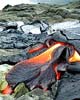
A new discovery of microbial activity in 3.5 billion-year-old volcanic rock and one of earth's earliest signs of geological existence sheds new light on the antiquity of life, says University of Alberta researchers who are part of a team that made the groundbreaking finding. |
|
|

| The content herein, unless otherwise known to be public domain, are Copyright 1995-2006 - SpaceDaily.AFP and UPI Wire Stories are copyright Agence France-Presse and United Press International. ESA PortalReports are copyright European Space Agency. All NASA sourced material is public domain. Additionalcopyrights may apply in whole or part to other bona fide parties. Advertising does not imply endorsement,agreement or approval of any opinions, statements or information provided by SpaceDaily on any Web page published or hosted by SpaceDaily. Privacy Statement |