|
 |
 |
 |
 |
 |
 |
 |
 |

 |
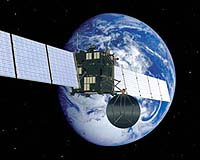
Boosting The Accuracy Of Rosetta's Earth Approach
Paris, France (ESA) Oct 22, 2007 Yesterday, 18 October at 18:06 CEST, the thrusters of ESA's comet chaser, Rosetta, were fired in a planned, 42-second trajectory correction manoeuvre designed to 'fine tune' the spacecraft's approach to Earth. Rosetta is now approaching Earth for its second planetary swing-by of 2007. After passing Mars in April 2007, Rosetta is now approaching Earth for the second time - the third of four planetary swing-bys that provide fuel-saving gravitational assists enabling the spacecraft to ultimately reach and cross the orbit of comet 64P/Churyumov-Gerasimenko in 2014. Rosetta's closest approach is predicted for 21:57 CET at a height of 5301 km over the Pacific Ocean and a speed of 45 000 km/h relative to the Earth. The third and last Earth swing-by will take place in November 2009.
Rosetta lines up A second trajectory correction slot, on 1 November, may also be used depending on results of an orbit determination scheduled for 30 October.
ESA's comet chaser After entering orbit around Comet 67P/Churyumov-Gerasimenko in 2014, the spacecraft will release the lander onto the icy nucleus. It will then spend the next two years orbiting the comet as it heads towards the Sun. On the way to Comet Churyumov-Gerasimenko, Rosetta has received gravity assists from Earth and Mars, and will fly past two main-belt asteroids - Steins (September 2008), and Lutetia (July 2010). Community Email This Article Comment On This Article Related Links Spacecraft Operations at ESA ESA's comet chaser: Rosetta Asteroid and Comet Mission News, Science and Technology
 Long-Lost, Dangerous Asteroid Is Found Again
 Mountain View CA (SPX) Oct 09, 2007
Echoing the re-discovery of America by the Spanish long after an earlier Viking reconnaissance, astronomers have learned that a recently observed asteroid - one that could potentially hit the Earth - was actually first observed nearly a half-century ago. Researchers at the Minor Planet Center of the Smithsonian Astrophysical Observatory in Cambridge, MA have confirmed work by SETI Institute astronomer Peter Jenniskens that the recently discovered asteroid 2007 RR9 is in fact the long-lost object 6344 P-L. |
|
|

| The content herein, unless otherwise known to be public domain, are Copyright 1995-2007 - SpaceDaily.AFP and UPI Wire Stories are copyright Agence France-Presse and United Press International. ESA Portal Reports are copyright European Space Agency. All NASA sourced material is public domain. Additional copyrights may apply in whole or part to other bona fide parties. Advertising does not imply endorsement,agreement or approval of any opinions, statements or information provided by SpaceDaily on any Web page published or hosted by SpaceDaily. Privacy Statement |