|
 |
 |
 |
 |
 |
 |
 |
 |

 |
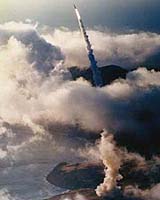
Boost Phase Blues Impact Missile Shield Developments
UPI Senior News Analyst Washington (UPI) Jun 16, 2006 The mainstream U.S. media usually simplifies the arguments both in favor of and against different kinds of ballistic missile defense systems. Repeatedly, simplified or out of date assertions are presented as - and accepted - as irrefutable fact. For a long time, even many skeptics of other aspects of BMD have sung the praises of developing boost phase anti-missile defenses. The idea was that intercontinental ballistic missiles are most vulnerable in the minutes after take off when they have not yet accelerated to hypersonic speeds, when they are still only in the lower atmosphere and when they cannot yet maneuver to evade ABM attacks. However, a report in the Los Alamos Monitor published June 15 at its LAMonitorOnline web-site looks likely to open a new phase in the boost phase debate. The LAMonitor reported a June 7 presentation to the Los Alamos Committee on Arms Control and International Security by Bill Priedhorsky, chief scientist of the Los Alamos National Laboratory's Threat Reduction Division and a senior fellow at the laboratory, in which Priedhorsky discussed the findings of a 2001 study on boost phase defense that he participated in. The study was organized by the American Physical Society and it was made public in October 2004 but attracted little attention at the time. "It was about as comprehensive a study as you can get without paying for it," Priedhorsky said according to the LAMonitor report. "Things that seem simple aren't as simple as they seem when you get to the bottom of them," he said. "... Boost-phase interception is always possible, if you are close enough to the launch pad and act early enough. But you can't stand 300 yards away with a machine gun." Priedhorsky noted that, in the case of North Korea and Iran, the two nations President George W. Bush identified with Saddam Hussein's regime in Iraq as members of an "axis of evil" in his 2002 State of the Union address, there were great difficulties facing the U.S. armed forces in deploying any ABM interceptors close enough to bring ICBMs down during their boost phase after launch. Quicker, peppier solid-fuel booster or multiple-staged rockets, rather than older liquid-fueled boosters now available to some of the countries of concern, would cut even more time off the few seconds available for identifying the threat, deciding what to do, and hurling a response at the problem, Priedhorsky said. The APS study in which Priedhorsky participated acknowledged some potential for using a boost-phase strategy against short- or medium-range missiles launched in coastal waters of the United States, if the ships armed with interceptors could stay within about 25 miles of the attacking ships. The APS study was careful to couch its terms in a way that would not rule out a policy decision. But altogether, the conclusion was that boost-phased defense was unlikely to be practical, considering all the factors, the LAMonitor report said. In fact, a major global summit that started this week in the Chinese city of Shanghai is likely to throw further doubt on the practicality of boost phase defenses against ICBMs launched not merely from North Korea or even Iran but from other nations. The fifth anniversary meeting of the Shanghai Cooperation Organization that started June 15 confirmed the clout of the body as an alignment of nations led by Russia and China against the extension of U.S. influence across the heartland of Asia. The organization also includes the former Soviet Central Asian republics of Kazakhstan, Tajikistan, Uzbekistan and Kyrgyzstan. Iran's hard-line President Mahmoud Ahmadinejad was a feted guest of honor at this year's gathering on the fifth anniversary of the group's founding. India and Pakistan both sent friendly observer delegations to participate in the activities and cooperate with the SCO. Boost phase defense is only practical if the defending power is free to both position and protect its boost phase ABM assets close enough to the launch sites of the targeted ICBMs to be able to intercept them during their first three or four minutes after launch. Therefore boost phase defenses simply could not be effective against launch sites deep in China, Russia or other SCO nations because they would be too far away from U.S. land bases or warships armed with boost phase interceptor missiles to be reached in time. But boost phase systems would also be highly vulnerable to preemptive attacks by any defending nation armed with sufficient weapons. For example, U.S. warships surrounding North Korea might be vulnerable attack from North Korean - or hypothetically even Chinese - warships armed with anti-ship missiles. The Chinese already have many of these including their home-produced Silkworms, which they have also supplied to Iran, and the Russian-made SS-N-22 Sunburn, which flies at Mach 2.2 and is regarded as the most lethal anti-ship missile in the world. More often than not, the facile ideas of politicians, think tankers and armchair strategists about ballistic missile defense fly in the face of the sober realities tackled by the aerospace scientists and engineers who actually have to design and built the weapons on which the lives of scores of millions of people may depend. But in the case of boost phase interceptors, the opposite process is at work. Boost phase defenses are an engineer's dream: They are more simple, straightforward and technically practical than most of the other systems being developed and deployed. But the geographical and strategic realities of the emerging 21st century world render them highly impractical for other reasons
Source: United Press International Community Email This Article Comment On This Article Related Links - Learn about missile defense at SpaceWar.com Learn about nuclear weapons doctrine and defense at SpaceWar.com All about missiles at SpaceWar.com Learn about the Superpowers of the 21st Century at SpaceWar.com
 Patriot Guidance Enhanced Missile Passes Key Test
 Washington (UPI) Jun 14, 2006
The Raytheon company announced June 5 that its Patriot Guidance Enhanced Missiles, or GEMs, destroyed two surrogate ballistic missile targets in a test at White Sands Missile Range, N.M. |
|
|

| The content herein, unless otherwise known to be public domain, are Copyright 1995-2006 - SpaceDaily.AFP and UPI Wire Stories are copyright Agence France-Presse and United Press International. ESA PortalReports are copyright European Space Agency. All NASA sourced material is public domain. Additionalcopyrights may apply in whole or part to other bona fide parties. Advertising does not imply endorsement,agreement or approval of any opinions, statements or information provided by SpaceDaily on any Web page published or hosted by SpaceDaily. Privacy Statement |