|
 |
 |
 |
 |
 |
 |
 |
 |

 |
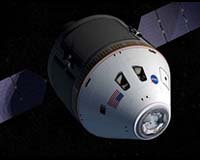
Boeing To Develop Advanced Thermal Protection System For Orion Spacecraft
St. Louis MO (SPX) Sep 21, 2006 The Boeing Company has received a NASA contract to design and develop a thermal protection system (TPS) for the Orion crew exploration vehicle -- America's next generation spacecraft that will carry astronauts to the International Space Station and the moon. The 16-month firm-fixed-price and cost-plus-fee contract has a maximum value of approximately $14 million including all priced options. The hybrid contract, awarded by NASA Ames Research Center, is for advanced development and risk reduction of a phenolic impregnated carbon ablator (PICA) heat shield to protect Orion from the extreme heat generated during reentry into the Earth's atmosphere. Orion is the first human element in NASA's Constellation program, the agency's initiative to support America's effort to return humans to the moon, Mars and beyond. Boeing's Advanced Network and Space Systems, a division of Boeing Advanced Systems, will participate with NASA in the Orion TPS development effort. "Orion's thermal protection system is a critical element of NASA's future human spaceflight missions," said George Muellner, president of Boeing Advanced Systems. "Our TPS team is focused on reducing the risks of this next generation heat shield technology to ensure the safety and success of these missions. We look forward to our continued involvement in space exploration and our successful partnership with NASA." Boeing has been NASA's partner since the beginning of the Space Age and is once again teamed with the agency to safely return humans to the moon. Boeing Space Exploration is pursuing the second element (Upper Stage and avionics sections) of the Constellation program that will launch Orion into orbit -- the Ares I crew launch vehicle. The Orion heat shield is being developed as an expendable ablative system that dissipates a portion of the extreme heat generated during atmospheric reentry by gradually burning away. The system will withstand lunar-direct return conditions, in which Orion will reenter Earth's atmosphere after a return from lunar missions. Lunar return conditions are characterized by much higher speeds and generate about five times greater heat than missions returning from the International Space Station. During the contract, Boeing and principle subcontractor Fiber Materials Inc. (FMI) will perform heat shield design, structural and thermal protection system material testing, sub-system analysis, and fabrication and integration of a full scale, five-meter diameter Manufacturing Development Unit heat shield. Boeing will provide heat shield integration and test coupon assemblies. FMI will fabricate all TPS components for the heat shield test and evaluation. NASA's Ames Research Center, partnering with other NASA Centers, will use its thermal, structural and environmental facilities to conduct extensive testing and evaluation of the PICA deliverables. The Ames-led inter-NASA team will assess the material performance and its risks and suitability for use as the Orion heat shield. NASA will work with Boeing to provide key validation and verification functions, as well as contribute toward the development and delivery of the overall preliminary heat shield design. The team also will conduct material property testing at laboratories located at Boeing in Huntington Beach, Calif., and at FMI in Biddeford, Maine. FMI fabricated PICA heat shield material for the NASA Stardust spacecraft that successfully returned to Earth earlier this year after a seven-year mission to collect particle samples from a flyby of Comet Wild 2. NASA is developing Orion as a primary vehicle for future human space exploration. Orion will carry astronauts to the International Space Station by 2014, with a goal of landing astronauts on the moon no later than 2020. Community Email This Article Comment On This Article Related Links Boeing Integrated Defense Systems Rocket Science News at Space-Travel.Com Lunar Dreams and more Rocket Science News at Space-Travel.Com
 First Vega P80 Nozzle Delivered
 Bordeaux, France (SPX) Sep 18, 2006
On 14 September 2006 a ceremony took place at the facilities of Snecma Propulsion Solide (SPS) in Bordeaux, France, to mark the occasion of the delivery of the first nozzle for the P80 solid rocket motor. The P80 is the first stage of the Vega small launcher. |
|
|

| The content herein, unless otherwise known to be public domain, are Copyright 1995-2006 - SpaceDaily.AFP and UPI Wire Stories are copyright Agence France-Presse and United Press International. ESA PortalReports are copyright European Space Agency. All NASA sourced material is public domain. Additionalcopyrights may apply in whole or part to other bona fide parties. Advertising does not imply endorsement,agreement or approval of any opinions, statements or information provided by SpaceDaily on any Web page published or hosted by SpaceDaily. Privacy Statement |